A tiny kitchen can work well, but only if every item on the counter earns its place. When square footage is limited, small appliances become the make-or-break factor. The right ones simplify daily routines. The wrong ones eat up prep space, block outlets, and make the kitchen feel cramped before you even start cooking.
This guide covers how to choose small appliances that save space in a tiny kitchen, studio apartment, or first apartment. It focuses on what actually matters: footprint, multi-use potential, storage, and how an appliance fits into a real small kitchen day after day.
What Makes a Small Appliance Truly Space-Saving?
A space-saving appliance is not just a smaller version of a standard one. It is an appliance you can use, clean, and put away without rearranging half the kitchen.
The first thing to check is the footprint. A compact coffee maker that is narrow and tall may fit better than a short, wide one that spreads across the counter. Depth matters too. An appliance that sticks out past the edge of the counter makes the kitchen feel tighter and is easier to bump into.
For exact examples of one-cup machines, filter methods, and storage-friendly manual brewers, see our guide to pod-free single-serve coffee makers for small apartments.
Beyond measurements, a space-saving appliance should be easy to move. If it lives in a cabinet most of the time, it needs to be light enough to lift, simple enough to set up in a few seconds, and compact enough to store without a struggle. An appliance that requires five minutes of rearranging every time you want to use it will quickly become an appliance you stop using.
Keep the Counter for Daily-Use Appliances
In a tiny kitchen, counter space is the most valuable real estate. It is where you chop vegetables, set down groceries, plate food, and stack dishes to dry. Every appliance that lives on the counter permanently takes away from that workspace.
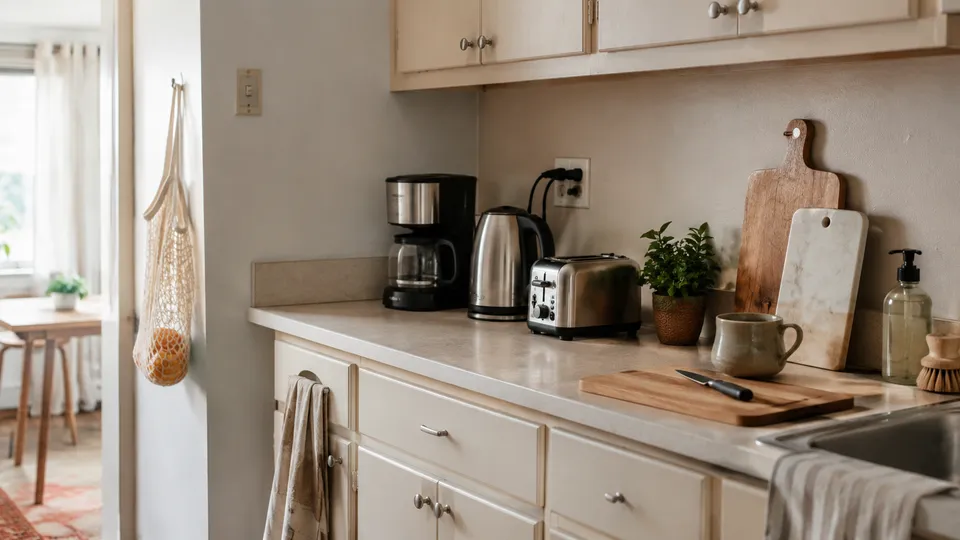
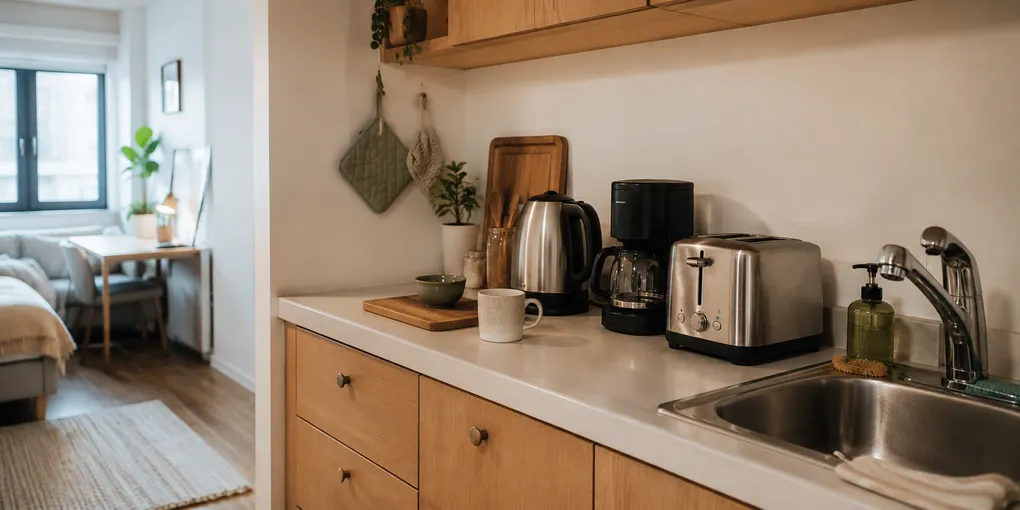
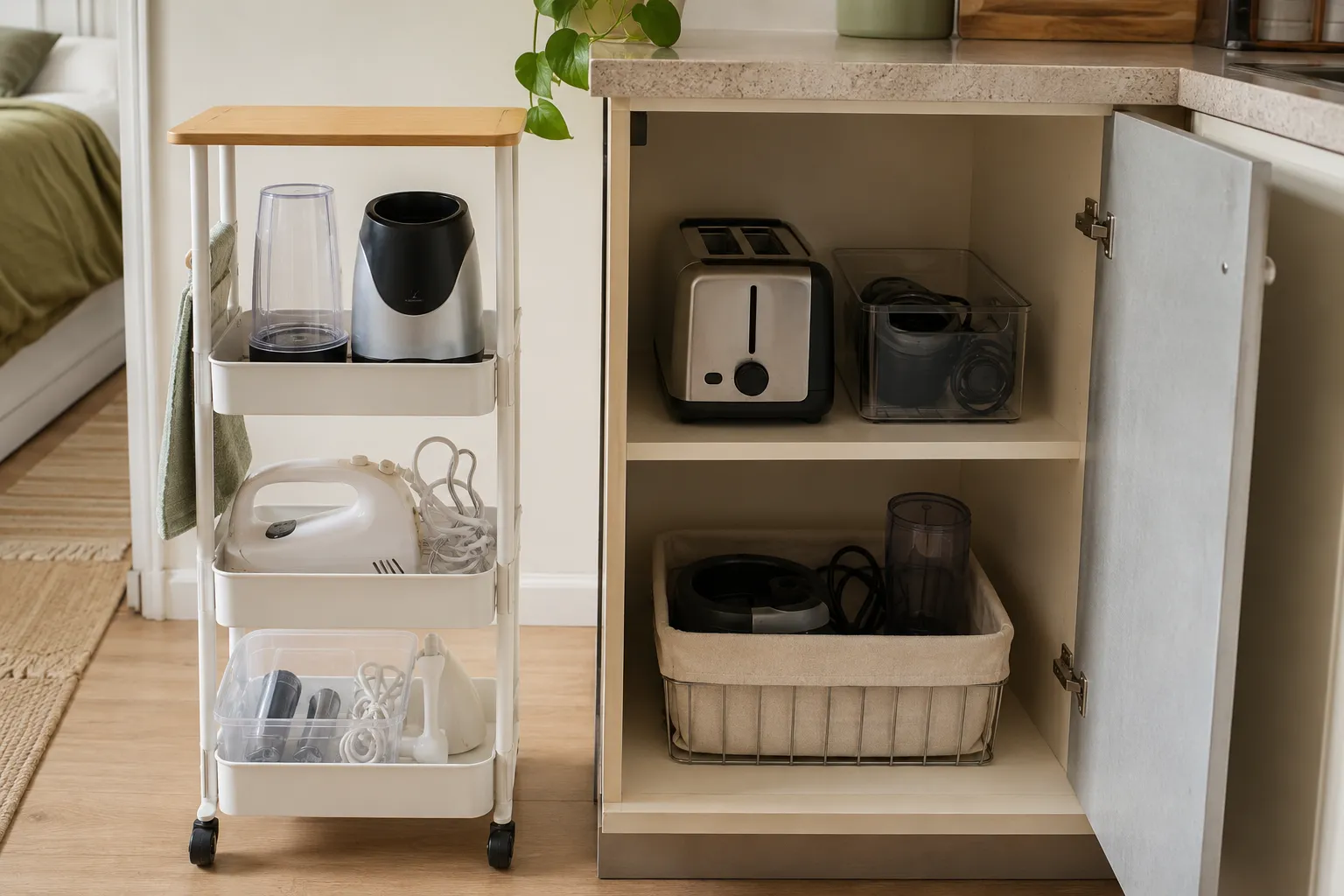
The rule is simple: only appliances you use every single day should live on the counter. For most people, that means a coffee maker or electric kettle, and maybe a toaster. Everything else should have a home in a cabinet, on a shelf, or in a storage cart.
This rule is not about being minimalist for its own sake. It is about being able to use your kitchen without constantly shifting appliances around just to make room for a cutting board.
If you are not sure whether an appliance deserves permanent counter space, put it away for a week. If you pull it out multiple times, it may deserve a spot. If you forget it exists, it does not.
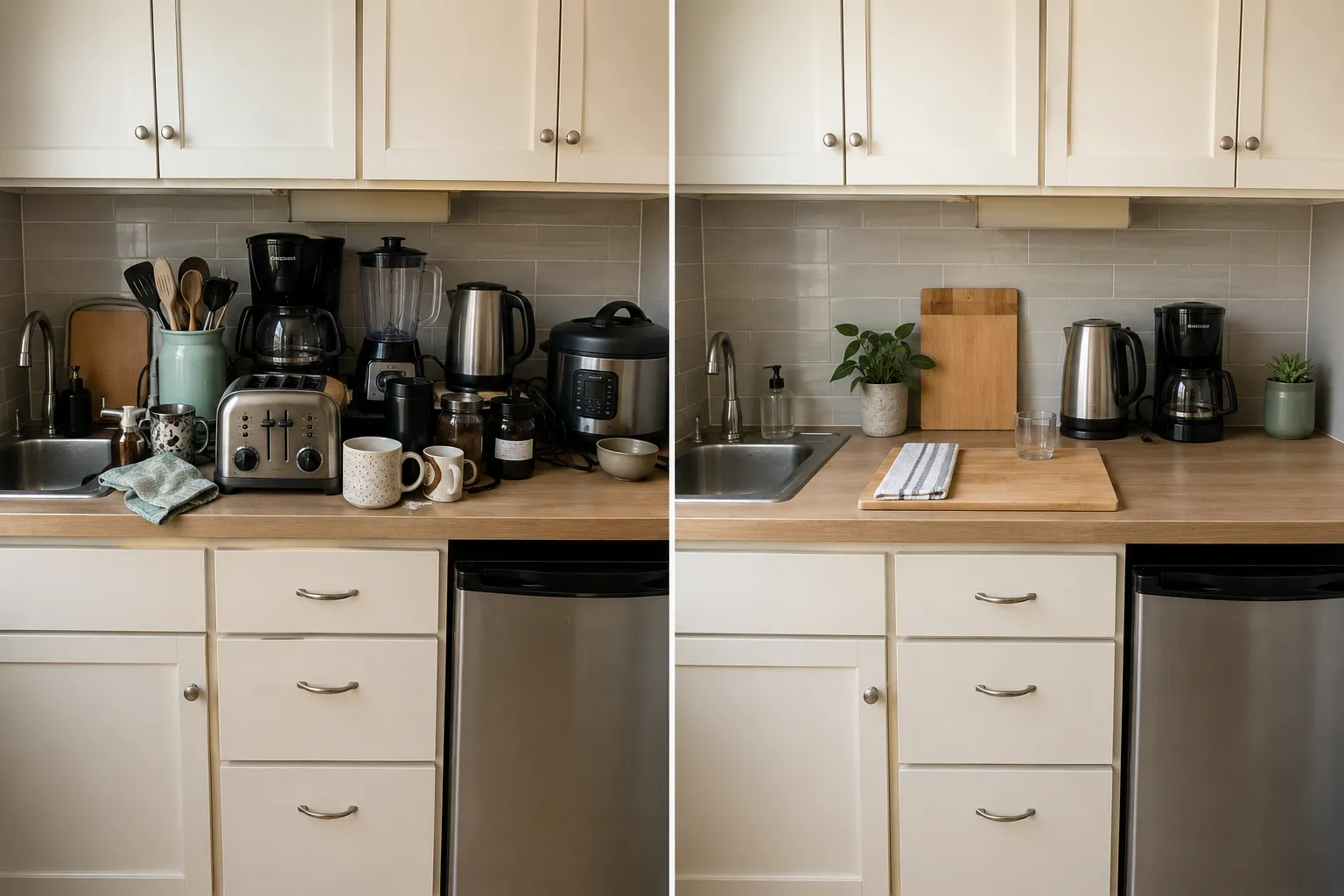
Avoid Duplicate Appliances in a Tiny Kitchen
One of the fastest ways to waste space in a small kitchen is owning two or more appliances that do essentially the same job. A toaster and a toaster oven. A blender and a food processor. A rice cooker and an Instant Pot. A drip coffee maker and a single-serve pod machine.
Before buying any new appliance, check whether something you already own can do the same job. A toaster oven can toast bread, reheat leftovers, and bake small portions. An electric kettle can make hot water for coffee, tea, oatmeal, and instant noodles. A compact food processor can chop, slice, and blend, potentially replacing both a blender and a manual chopping setup.
Coffee equipment is an easy place to duplicate functions: a pod machine, a drip machine, and a grinder can all compete for the same small counter. Our comparison of coffee pods vs. ground coffee for a small apartment can help you choose one routine before adding more equipment.
Choosing multi-use appliances is one of the most effective ways to save space in a tiny kitchen. It reduces the total number of items on the counter and in the cabinets without reducing what you can actually make.
Space-Saving Features Worth Looking For
When comparing small appliances for a tiny kitchen, a few specific features make a real difference in day-to-day use.
Vertical orientation. Appliances with a narrow, tall shape use less counter width. This matters in a small kitchen where counter depth is already fixed but width is at a premium.
Built-in cord storage. A retractable or wrap-around cord keeps the counter and cabinet tidier and reduces the tangled-cord look that makes small kitchens feel chaotic.
Removable, stackable parts. Attachments, lids, and accessories that nest or stack take up less cabinet space than parts that each need their own spot.
Lightweight body. If the appliance will be stored in a cabinet and pulled out for use, weight matters. A heavy stand mixer or bulky food processor is much less likely to be used regularly if lifting it feels like a chore.
Simple controls. Digital displays and touchscreens can be harder to clean and more prone to failure from moisture or grease. Simple knobs, buttons, and switches tend to hold up better and take less time to figure out when you are already busy.
None of these features are about luxury. They are about fitting an appliance into a real small kitchen where every inch and every minute counts.
Simple Tiny Kitchen Setups
Every tiny kitchen is different, but a few appliance setups work well across many small spaces.
The essentials-only setup. A compact coffee maker or electric kettle, a toaster or toaster oven, and a microwave if one is not built in. These three cover breakfast, reheating, and basic meal prep. Everything else is optional.
The cooking-focused setup. An induction hot plate or compact multi-cooker, a small rice cooker, and an electric kettle. This setup works for someone who cooks most meals at home and is willing to dedicate counter space to cooking tools.
The breakfast-and-snacks setup. A single-serve blender for smoothies, a toaster, and a compact coffee maker. This setup prioritizes morning routines and quick snacks over full meal preparation.
In all of these setups, the key is that every appliance on the counter gets used at least once a day. Appliances used less often live in cabinets or on a storage cart.
Think About Outlets, Cords, and Heat
Small kitchens often have limited outlets, and older apartments may have older wiring. Plugging two high-wattage appliances into the same outlet can trip a breaker, especially if both produce heat.
Toasters, air fryers, countertop ovens, and electric kettles all draw significant power. In a tiny kitchen with only one or two accessible outlets, plan which appliances can run at the same time safely.
Cords matter too. A cord that drapes across the sink, trails over the stove, or hangs off the front of the counter is a safety hazard. Look for appliances with cords that are long enough to reach the outlet without stretching but short enough to manage neatly. If the cord is too long, use a cord wrap or clip to keep it tidy. Do not use multi-plug adapters or power strips with high-wattage kitchen appliances.
Heat-producing appliances also need breathing room. A toaster pushed against a wall or squeezed under a low cabinet is a fire risk. Leave several inches of clearance on all sides of any appliance that gets hot during use. In a tiny kitchen, this ventilation space can be the deciding factor. Measure the counter, subtract the required clearance, and check whether the appliance still fits before buying.
Small Kitchen Appliance Comparison
This table compares common small appliances by how much counter space they typically need, whether they can do more than one job, and how practical they are in a tiny kitchen.
| Appliance | Counter Footprint | Multi-Use Potential | Tiny Kitchen Fit |
|---|---|---|---|
| Compact coffee maker | Small to medium | Low (makes coffee) | Good if you drink coffee daily |
| Electric kettle | Small | Medium (hot water for many uses) | Excellent; narrow and versatile |
| Toaster (2-slice) | Small | Low (toasts bread) | Good for daily toast eaters |
| Toaster oven (compact) | Medium | High (toast, reheat, bake small portions) | Better than a toaster if you will use the extra functions |
| Single-serve blender | Small | Low to medium (smoothies, sauces, small batches) | Good if used several times a week |
| Full-size blender | Large | Medium (smoothies, soups, sauces) | Poor; bulky base and tall jar |
| Compact food processor | Small to medium | High (chop, slice, blend, mix) | Good; may replace a blender and manual prep |
| Air fryer (compact) | Medium | Medium (crisp, reheat, cook small portions) | Fair; needs ventilation clearance |
| Stand mixer | Large | Medium (mix, knead, whip) | Poor for most tiny kitchens; heavy and bulky |
| Rice cooker (compact) | Small | Low to medium (rice, grains, sometimes steam) | Good if rice is a staple |
| Multi-cooker (3-6 quart) | Medium | High (pressure cook, slow cook, rice, steam, sauté) | Good if it replaces several other appliances |
FAQ
What small appliances do I actually need in a tiny kitchen?
For most people, the core two or three are a coffee maker or electric kettle, a toaster or compact toaster oven, and a microwave if one is not built in. These cover breakfast, reheating, and basic meal prep. Everything else — blenders, air fryers, food processors, rice cookers — can wait until you know you will use them regularly and have a place for them.
How do I decide which appliance stays on the counter?
Keep only the appliances you use every single day on the counter. If you use a coffee maker every morning and a toaster every other day, the coffee maker stays out and the toaster goes in a cabinet. If counter space is extremely limited, even daily-use appliances may need to be stored and pulled out each morning. The test is simple: if you put an appliance away in a cabinet and never bother to pull it out, you probably did not need it on the counter in the first place.
Is an air fryer worth it in a tiny kitchen?
An air fryer can be useful if you cook for one or two people and value speed and crisp results. But it takes up significant counter space and needs clearance on all sides for venting. In a very small kitchen, a compact toaster oven with a convection setting may cover similar jobs in a more versatile footprint. Whether an air fryer is worth it depends entirely on how often you will use it versus how much counter space you will lose.
How do I store small appliances I do not use every day?
Keep them in a lower cabinet or on a shelf that is easy to reach without bending too much or climbing. Avoid the highest shelf and the deepest corner of a base cabinet. If you use an appliance a few times a week, consider a small rolling cart that can sit against a wall or tuck into a corner. Wrap cords neatly and store attachments together so you can grab everything in one trip. If an appliance lives in a spot that requires moving three other things to reach it, it will almost never get used.
Should I buy compact or full-size appliances?
In a tiny kitchen, compact is almost always the better choice. A compact coffee maker, a 2-slice toaster, a single-serve blender, and a 3-cup rice cooker all take up less space and are sized appropriately for one or two people. Full-size versions of these appliances are designed for larger households and larger kitchens. Unless you regularly cook for a crowd, a compact appliance will handle your daily needs without overwhelming your counter.
What if I have almost no counter space at all?
Focus on the one or two appliances you cannot do without and keep only those out. Consider whether stovetop alternatives can replace electric ones: a stovetop kettle instead of an electric one, or a pot on the stove instead of a rice cooker. Use vertical storage like wall-mounted shelves, a slim rolling cart, or an over-the-sink cutting board that expands your work surface. In the smallest kitchens, sometimes the best small appliance is the one you decide not to buy.
Can I use a power strip for my kitchen appliances?
No. High-wattage kitchen appliances that produce heat — toasters, air fryers, electric kettles, countertop ovens — should always be plugged directly into a wall outlet, one at a time per outlet. Power strips and multi-plug adapters are not designed for the sustained high wattage these appliances draw and can create a fire risk.
For the hand tools and cookware worth buying before countertop appliances, read essential kitchen tools for a first apartment.
Final Thoughts
A tiny kitchen does not need to feel limited. It needs appliances that fit the space, match your actual routine, and do not create daily friction around storage, outlets, or cleanup.
Before bringing any new appliance into a small kitchen, measure the counter, check the outlet situation, plan where it will live when not in use, and ask yourself honestly whether something you already own can do the same job. The best small appliance for a tiny kitchen is often the one that replaces two others.
A well-chosen set of compact, multi-use appliances can make a small kitchen feel more capable, not more crowded. The goal is not to own less for the sake of it. It is to keep the counter clear enough that you can actually use the kitchen without a battle every time.