Moving into a first apartment comes with a long list of things to buy. Somewhere between the furniture and the shower curtain, small appliances start to seem urgent. A coffee maker. A toaster. Maybe an air fryer or a blender. Suddenly the counter fills up fast, and you realize the kitchen has exactly two outlets and almost no storage.
Small appliances can make daily life easier, but they can also become expensive counter clutter if you choose the wrong ones. The ones that earn their space are the ones that fit your actual routine, your real kitchen layout, and the way you cook, clean, and store things day to day.
Some apartment appliances need a separate check because water and drainage are involved. Before treating one as just another compact purchase, see our guide to portable washing machines for apartments, which covers faucet compatibility, drain routing, floor stability, capacity, and rental limitations.
This guide walks through what to check before buying small appliances for a first apartment, so you end up with tools that help rather than boxes that live in the back of a cabinet.
Start With Your Real Routine, Not a Hypothetical One
Before looking at specific appliances, look at what you actually eat and drink during a normal week.
Someone who makes pour-over coffee every morning will use an electric kettle daily. Someone who buys coffee on the way to work may never touch it. A blender matters if you make smoothies, soups, or sauces regularly. It’s a dust collector if smoothies are a once-a-year thing.
The most common first-apartment mistake is buying appliances for the person you want to be rather than the person you already are. You picture weekend brunches, homemade soups, and fresh juice. In reality, you’re making toast, reheating leftovers, and brewing coffee before you’re fully awake.
Start with the appliances that match your real habits. A coffee maker, a toaster or toaster oven, and a microwave already cover most first-apartment needs. Everything else should earn its place based on how often you’ll actually use it.
Measure Limited Counter Space in a Small Kitchen
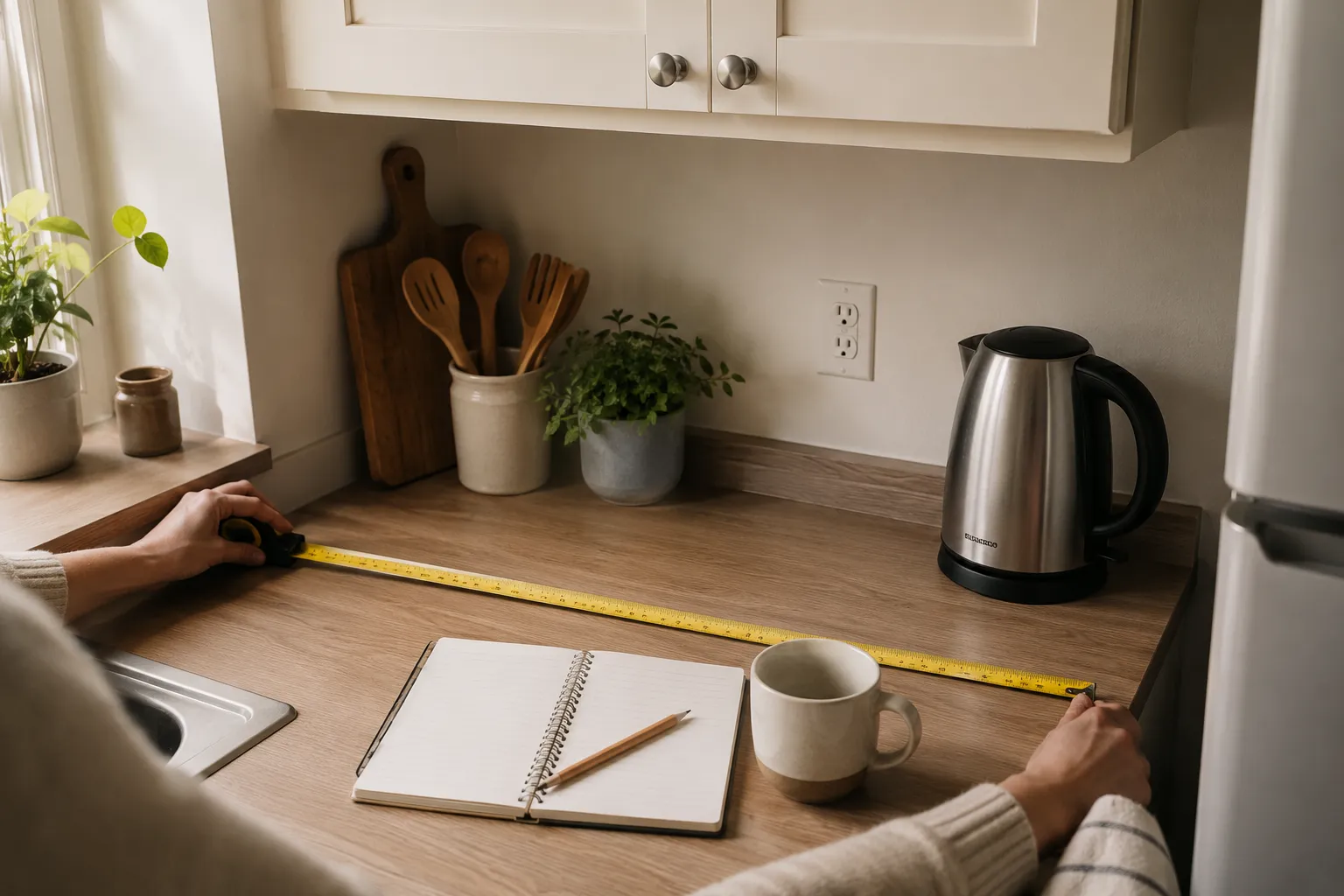
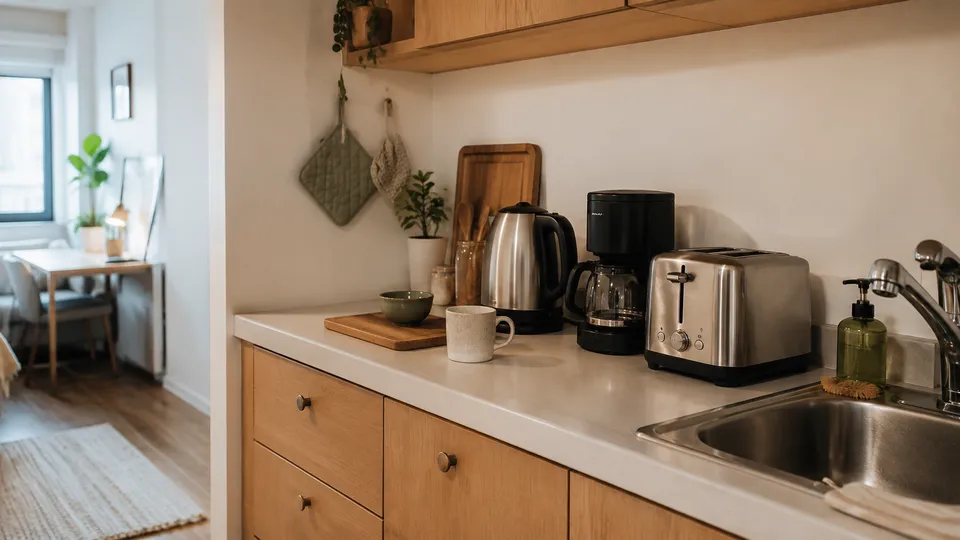
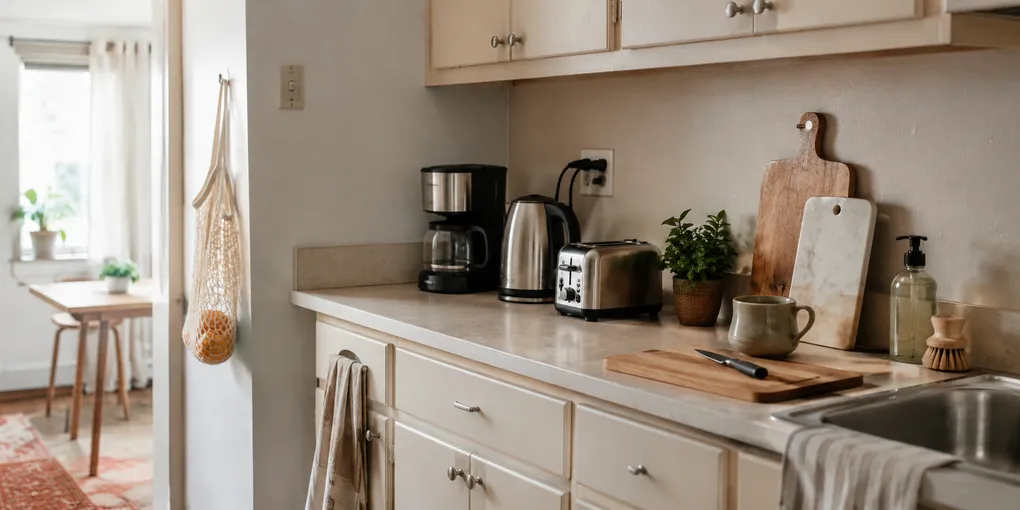
First-apartment kitchens are often small, and counter space disappears faster than you expect. A coffee maker, a toaster, and a dish-drying rack can fill most of the available surface in a compact kitchen.
Before buying any appliance, measure the counter space where it will live. Not just the width of the counter, but the depth too. Some appliances need extra clearance behind them for vents, cords, or lid clearance. An appliance that technically fits can still make a counter feel cramped if it leaves no room for a cutting board or a dinner plate.
Also measure the space under upper cabinets. Many small appliances, especially coffee makers and stand mixers, need enough vertical clearance to open lids, load beans, or lift mixer heads. An appliance that fits on the counter but can’t fully open under a cabinet becomes frustrating fast.
For a coffee setup that fits one person or a small counter, see our comparison of pod-free single-serve coffee makers for small apartments. It covers actual machine dimensions, filter methods, and which setups can be stored away after use.
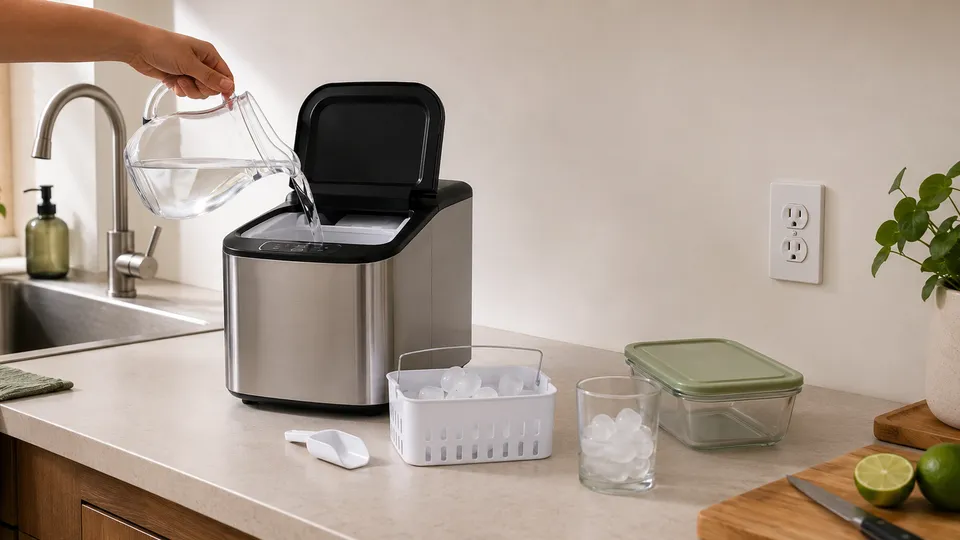
If ice is part of your regular drink routine, use the same measurement-first approach before adding another permanent appliance. Our guide to countertop ice makers for small apartments compares compact bullet and nugget-ice options by working footprint, refilling, ice storage, and cleanup rather than daily-output claims alone.
If counter space is already tight, consider appliances that can do more than one job. A toaster oven can handle toast, reheating, and small baking tasks. An electric kettle can make hot water for coffee, tea, instant noodles, and oatmeal. A compact food processor can chop, slice, and blend without needing a separate blender.
Picking multi-use appliances is not about being minimalist. It’s about not running out of room to actually use the kitchen.
Think About Storage Before Attachments
Many small appliances come with extra parts: blender jars, chopping bowls, steamer baskets, egg inserts, mixing paddles, and specialty blades. These attachments multiply the storage problem.
A blender with three jar sizes sounds versatile, but if two of the jars live in the back of a cabinet and never come out, they’re just taking up space. A food processor with seven blades is useful only if you’ll actually use more than two of them.
Before buying, check where every attachment will go. If the answer is a cabinet that’s already full, consider a simpler model. A compact appliance that you can pull out and put away easily will get used more often than a feature-packed one that requires a ten-minute excavation to set up.
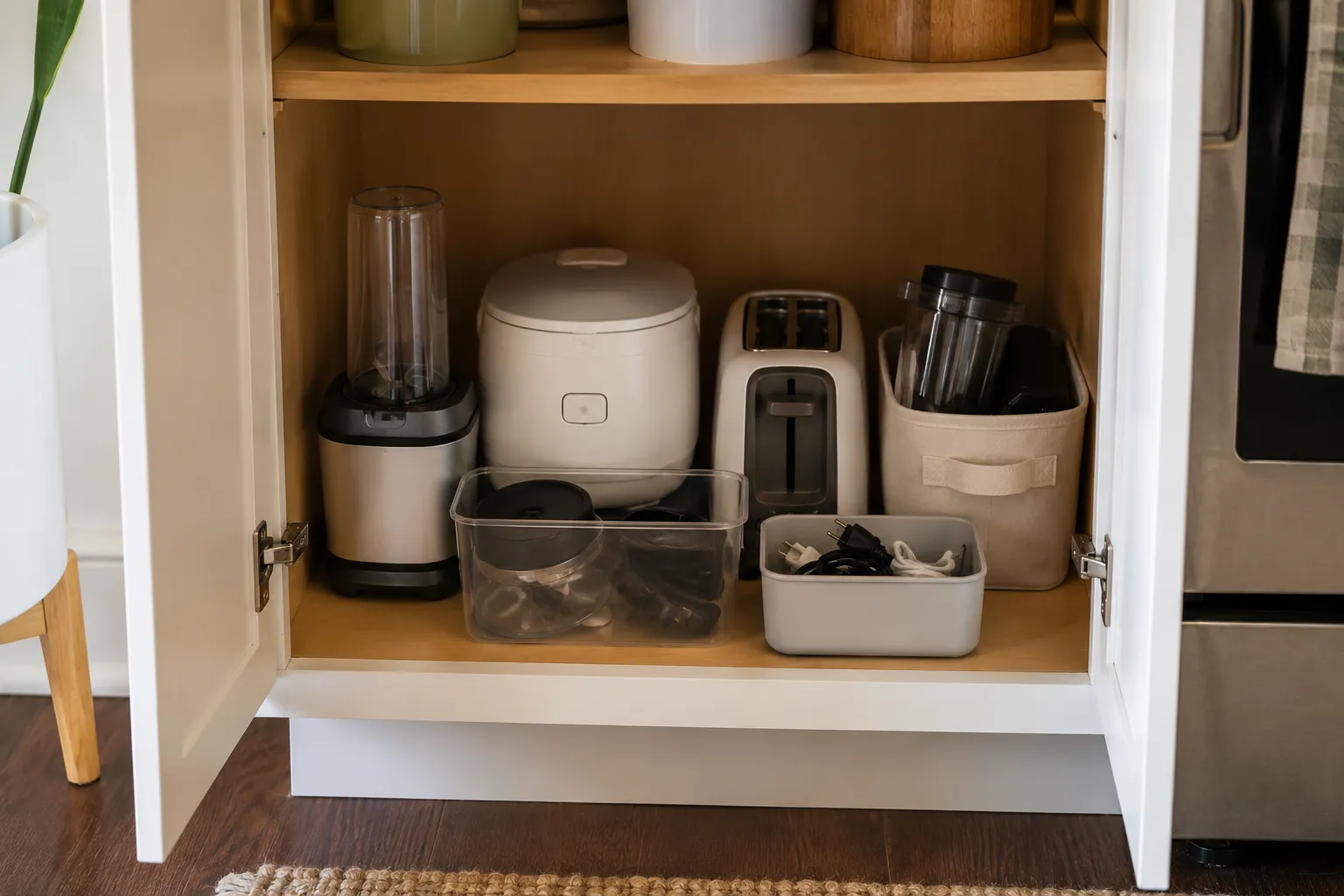
Storage matters for the appliance itself too. If the appliance won’t live on the counter full-time, it needs a designated home that’s easy to reach. Appliances stored in the highest cabinet or the deepest corner of a lower cabinet tend to stay there. If pulling it out feels like a project, you’ll stop using it.
Check Wattage, Outlets, and Circuit Breakers
First apartments often have limited outlets, and older buildings may have older wiring. Plugging a high-wattage appliance into an outlet that also runs the microwave, the toaster, or a space heater can trip a breaker.
Before buying, check the appliance’s wattage and compare it to what the outlet and circuit can handle. Small appliances that produce heat — toasters, air fryers, electric kettles, countertop ovens — tend to draw the most power.
If the kitchen has only one or two accessible outlets, plan which appliances can run at the same time. Running an air fryer and a toaster on the same outlet may not work safely. Running a coffee maker and an electric kettle at the same time can create the same problem.
For kitchens with very few outlets, look for appliances with shorter cords that won’t trail across the sink or stove. A cord that’s too short can be fixed with an appropriate extension setup. A cord that drapes across a hot surface or a wet area is a safety risk that’s not worth taking.
Don’t use multi-plug adapters or power strips with high-wattage kitchen appliances. Plug heat-producing appliances directly into a wall outlet, one at a time per outlet.
Give Heat-Producing Appliances Breathing Room
Toasters, air fryers, countertop ovens, and other heat-producing appliances need clear space around them. They shouldn’t be pushed against a wall, squeezed under a low cabinet, or placed directly next to another heat source.
Check the manufacturer’s clearance recommendations for ventilation. As a general rule, leave at least several inches of space on all sides of any appliance that gets hot during use. Never place a heat-producing appliance on top of a flammable surface like a towel, paper, or plastic mat.
In a small kitchen, this clearance requirement can be the deciding factor. An appliance that needs six inches of space on every side may not fit the only available counter spot. Measure the counter, subtract the clearance, and then decide if the appliance still makes sense.
Choose Appliances That Are Easy to Clean
An appliance that’s hard to clean becomes an appliance you avoid using.
Blenders with non-removable blades, air fryers with complicated basket assemblies, and coffee makers with tiny crevices around the water reservoir all create cleaning friction. The more steps it takes to clean, the more likely you are to leave it dirty and order takeout instead.
Look for appliances with smooth surfaces, removable dishwasher-safe parts, and minimal crevices where food and liquid can collect. A simple design usually means easier cleaning.
Also think about where you’ll clean it. In a small apartment kitchen, the sink is often compact. A blender jar that barely fits under the faucet or a bulky air fryer basket that splashes water everywhere makes cleanup more frustrating than it needs to be. Choose sizes that match your sink and your willingness to deep-clean after every use.
Size Appliances for One or Two People
Most small appliances come in a range of sizes, and the largest model is rarely the right one for a first apartment.
A 12-cup coffee maker makes sense for a family or an office. For one or two people, a compact 5-cup model or a single-serve setup often fits better and takes up less counter space. A large air fryer can cook a whole chicken, but in a small kitchen, a compact model that handles a couple of servings is easier to store, clean, and use daily.
The same principle applies to blenders, food processors, rice cookers, and slow cookers. A smaller capacity means a smaller footprint, less storage space, and fewer leftovers you didn’t actually want.
Stick to a Budget That Makes Sense for a First Apartment
Small appliances range from very affordable to surprisingly expensive. For a first apartment, you don’t need the top of every category.
A basic toaster that toasts bread evenly, a coffee maker that brews reliably, and an electric kettle that boils water quickly don’t need to cost a lot. Premium features like precision temperature control, digital displays, and app connectivity are rarely necessary for a first kitchen.
Spend where it matters for your routine. If coffee is a daily ritual, a reliable coffee maker or kettle is worth more of the budget. If you mostly reheat leftovers and make toast, put the money toward a solid toaster oven instead of spreading it across appliances you’ll barely use.
Before buying a pod machine or a ground-coffee setup, compare the daily storage, cleanup, and supply tradeoffs in coffee pods vs. ground coffee for a small apartment.
It’s often better to buy fewer appliances that work well than to fill the counter with cheap ones that break, burn food unevenly, or annoy you every time you use them. Start with the essentials, live with them for a while, and add more only when you genuinely need them.
First Apartment Small Appliance Checklist
Use this checklist to evaluate any small appliance before bringing it into a first apartment. If you can’t answer most of these questions comfortably, the appliance may not be the right fit yet.
- Routine: Will I use this at least a few times a week based on how I actually eat and drink?
- Counter space: Do I have a measured spot where it fits with enough clearance on all sides?
- Under-cabinet clearance: Can I fully open lids, lift tops, and access controls under my upper cabinets?
- Storage: If it doesn’t live on the counter, do I have an easy-to-reach cabinet or shelf for it?
- Attachments: Where will every extra part, blade, and accessory go?
- Outlet: Do I have a safe, accessible outlet on a circuit that can handle the wattage?
- Heat clearance: If it produces heat, is there enough breathing room around the planned spot?
- Cleaning: Are the main parts dishwasher-safe or easy to clean by hand in my sink?
- Size: Is this sized for one or two people rather than a large household?
- Multi-use potential: Can one appliance cover two or more jobs I actually need done?
- Budget: Is this the right priority for my budget right now, or could a simpler model do the same job?
If an appliance checks most of these boxes, it’s likely a good fit. If several answers feel shaky, wait until your routine, kitchen layout, or budget make the choice clearer.
FAQ
What small appliances do I actually need for a first apartment?
For most people, the core three are a coffee maker or electric kettle (depending on your morning drink), a toaster or toaster oven, and a microwave if one isn’t already built in. These cover breakfast, reheating, and basic meal prep. Everything else — blenders, air fryers, food processors, rice cookers — can wait until you know you’ll use them regularly.
How do I fit small appliances in a tiny kitchen with almost no counter space?
Prioritize the one or two appliances you use daily and keep only those on the counter. Store the rest in an easy-to-reach cabinet or shelf. Choose compact or single-serve sizes. Look for appliances that can do double duty, like a toaster oven that also reheats and bakes small portions. If counter space is extremely limited, consider whether a stovetop kettle could replace an electric one, or whether manual tools could replace a bulky machine.
Is an air fryer worth the counter space in a small kitchen?
An air fryer can be useful if you cook for one or two people frequently and value speed and crisp results. But it takes up significant counter space and needs clearance for venting. Whether it’s worth it depends on how often you’ll use it versus how much counter space you’ll lose. In a very small kitchen, a toaster oven with a convection setting may cover similar jobs in a more versatile footprint.
How do I know if an appliance will trip my breaker?
Check the appliance’s wattage on the label or product details. Heat-producing appliances (toasters, air fryers, kettles) often use 1000 to 1800 watts. If two high-wattage appliances share the same outlet or circuit, running them at the same time can trip a standard 15-amp breaker. In older apartments with limited circuits, plug major appliances into different outlets and avoid running more than one at a time.
Should I buy all my small appliances before moving in?
No. Start with the absolute basics — coffee maker or kettle, toaster, and microwave. Live in the space for a few weeks first. You’ll learn where the outlets are, which counters you actually use for prep, how much storage you really have, and what your daily cooking rhythm looks like. Buying appliances after you know the space almost always leads to better choices.
What’s the best way to store small appliances I don’t use every day?
Keep them in a lower cabinet or shelf that’s easy to reach without bending or climbing. Avoid the highest shelf and the deepest corner. If an appliance has a cord, wrap it neatly and store attachments together so you can grab everything in one trip. If you find yourself never using a stored appliance because it’s too hard to get to, that’s a sign it either needs a more accessible home or a new owner.
Final Thoughts
Small appliances should make a first-apartment kitchen easier to use, not harder to navigate. The ones worth keeping are the ones that match your real routine, fit your actual counter space, and don’t create daily friction around cleaning, storage, or outlet access.
Before bringing any new appliance home, measure the spot, check the outlet, plan the storage, and ask yourself honestly how often you’ll use it. A compact, simple appliance that you pull out every day is worth more than a feature-rich one that sits in a cabinet collecting dust.
A first-apartment kitchen doesn’t need to be filled with gadgets to function well. It needs a few reliable tools that earn their space, day after day.