Setting up a first apartment kitchen can feel like a long list of things to buy. Walk into any kitchen store and the shelves are full of gadgets, specialty tools, and sets that promise to cover every cooking scenario. But most beginners do not need a fully stocked kitchen on day one. They need a small set of reliable tools that cover the meals they actually make.
This guide walks through the essential kitchen tools worth having in a first apartment, with an emphasis on what works in a small kitchen, what fits a beginner’s routine, and what can wait until later.
Start With the Meals You Actually Make
Before buying anything, look at what you cook right now, not what you hope to cook someday. If dinner is pasta, scrambled eggs, roasted vegetables, and the occasional stir-fry, your tool list is shorter than someone who bakes bread every weekend.
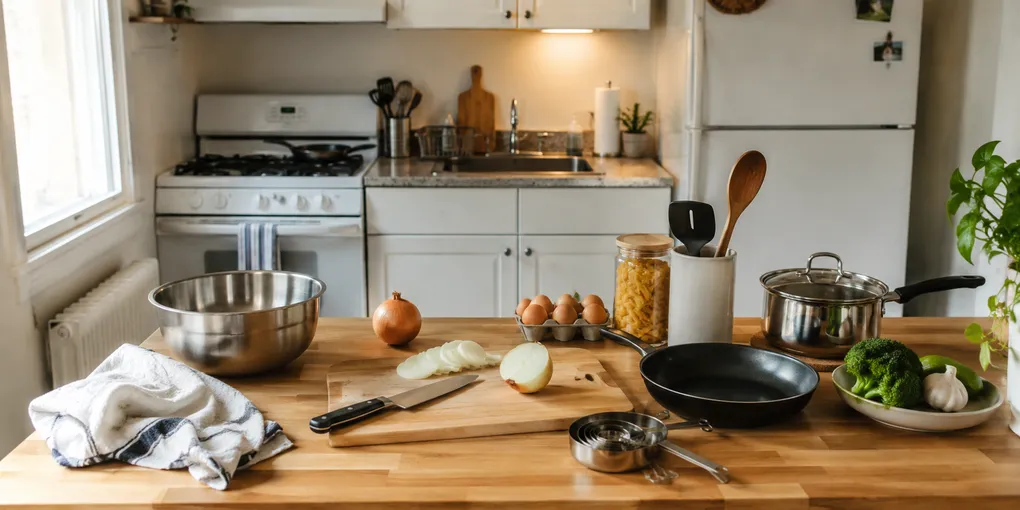
Start with the tools that match your real habits. A chef’s knife, a cutting board, one skillet, one saucepan, a mixing bowl, and basic utensils can already handle a surprising number of meals. You can always add more tools later, once you know which gaps actually slow you down.
This approach also keeps a small kitchen manageable. Every tool that enters a first apartment needs a place to live. It is easier to start with the essentials and add thoughtfully than to fill drawers with tools you barely touch.
Kitchen Essentials for Prep Work
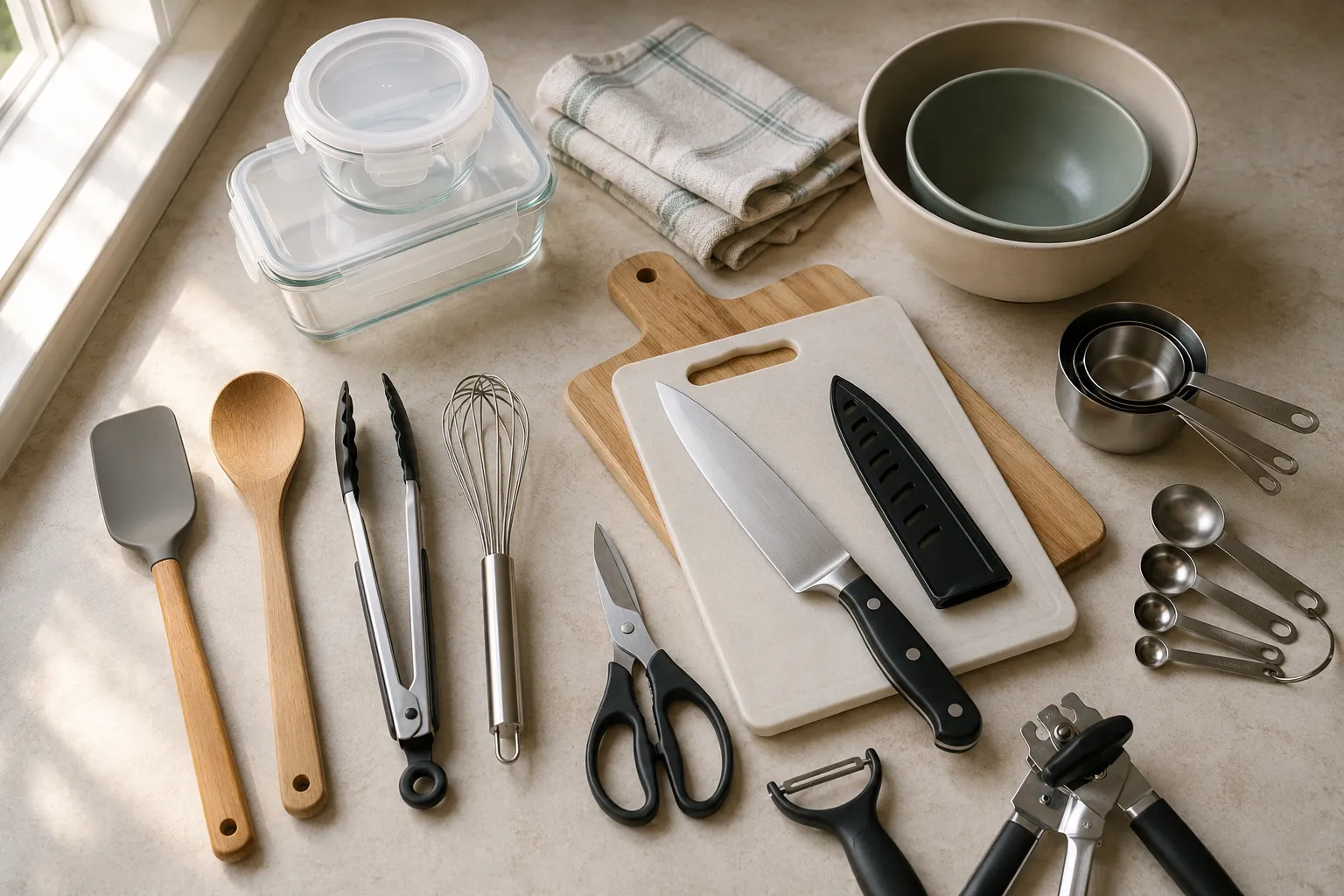
Prep work — washing, chopping, measuring, and mixing — is where most meals begin. A few well-chosen tools make this part of cooking faster and less frustrating.
Chef’s knife. This is the most important tool in the kitchen. An 8-inch chef’s knife handles chopping, slicing, dicing, and mincing for vegetables, herbs, meat, and more. You do not need a full knife block. One good chef’s knife covers most tasks, and a small paring knife handles the rest. Look for a knife that feels comfortable in your hand and has a blade that holds an edge reasonably well.
Cutting board. A sturdy cutting board protects your counters and your knife. Wood and bamboo boards are durable and gentle on knife edges. Plastic boards are lightweight, affordable, and dishwasher-safe. If space is tight, a single medium-sized board is enough. Avoid glass or stone boards — they are hard on knives and noisy to use.
Measuring cups and spoons. A set of dry measuring cups and a set of measuring spoons cover most recipes. A liquid measuring cup with clear markings handles wet ingredients. These are simple tools, but they make a real difference when you are following a recipe for the first time.
Mixing bowls. Two or three mixing bowls in different sizes cover prep, mixing, and serving. Stainless steel is lightweight, durable, and easy to clean. Glass bowls let you see what is inside and can go in the microwave. Nesting bowls save cabinet space, which matters a lot in a small kitchen.
Colander or strainer. You need something to drain pasta, rinse vegetables, and wash produce. A basic colander or a mesh strainer does the job. If storage space is extremely limited, a collapsible colander can help.
Cookware Starter List for a Small Kitchen
A full cookware set looks appealing, but a first apartment kitchen usually needs only a few core pieces.
Nonstick skillet (10-inch or 12-inch). This is the workhorse for eggs, pancakes, sautéed vegetables, and delicate foods. A nonstick skillet is forgiving for beginners and easy to clean. Use wood, silicone, or nylon utensils to protect the surface, and avoid metal tools that can scratch the coating.
Saucepan with lid (2-quart or 3-quart). A medium saucepan handles pasta, rice, soup, oatmeal, and reheating leftovers. The lid helps food cook faster and prevents splatters. This is one of the most-used pans in a first kitchen.
Sheet pan. A rimmed baking sheet is useful for roasted vegetables, sheet-pan dinners, and even reheating pizza. It is simple, inexpensive, and takes up very little space. A half-sheet pan fits most apartment ovens.
Stockpot or larger pot (5-quart or 6-quart). This handles bigger batches of soup, chili, pasta for guests, and boiling water for corn or potatoes. If storage is tight, this can be one of the items you add later, once you know you will use it.
That is four pieces of cookware, and they cover the vast majority of beginner meals. You can add a cast-iron skillet, a sauté pan, or specialty bakeware later, as your cooking routine expands.
Cooking Utensils Worth Having
A drawer full of utensils can look busy without being useful. These are the ones beginners reach for most often.
Spatula or turner. For flipping eggs, pancakes, burgers, and moving food around a skillet. A silicone or nylon spatula is safe for nonstick pans. A thin metal spatula works better for cast iron and stainless steel.
Wooden spoon or silicone spoon. For stirring sauces, soups, and sautéed vegetables. A wooden spoon is simple and durable. A silicone spoon is heat-resistant and dishwasher-safe.
Tongs. Tongs act like an extension of your hand. They grip food for flipping, turning, and serving. Look for tongs with a locking mechanism so they stay closed in the drawer.
Whisk. For eggs, pancake batter, sauces, and salad dressings. A basic balloon whisk in a medium size covers most needs.
Vegetable peeler. A Y-shaped peeler is comfortable to hold and makes quick work of potatoes, carrots, and other produce.
Can opener. A manual can opener is reliable and takes up minimal space. Electric can openers are rarely worth the counter footprint in a small kitchen.
Kitchen scissors. Useful for opening packages, trimming herbs, cutting kitchen twine, and sometimes cutting food directly. A pair of dedicated kitchen scissors is easier to keep clean than using the same scissors for paper and plastic.
Eating and Drinking Basics
The tools you use to eat and drink deserve as much attention as the tools you cook with. In a first apartment, these items also serve as a large portion of your kitchen storage.
Plates and bowls. One set of dinner plates and one set of bowls for each person in the household, plus a couple of extras for guests. Start small. You can always add more later.
Drinking glasses. A few versatile glasses work for water, juice, and other cold drinks. If you have coffee or tea drinkers, a few mugs cover hot beverages.
Flatware. Knives, forks, and spoons for each person. A simple stainless steel set handles daily meals and holds up well over time.
Mugs. Mugs pull double duty in a first apartment: they hold coffee and tea in the morning, and they can double as small prep bowls, soup cups, or dessert dishes when needed. Four mugs is a comfortable number for one or two people.
The goal is not to fill every cabinet with dishware. It is to have enough for a normal day plus one or two guests, without stacking plates so high they are hard to reach.
Food Storage for Leftovers and Meal Prep
Food storage containers are easy to overlook when setting up a first kitchen, but they make a big difference in daily life. They hold leftovers, packed lunches, prepped ingredients, and partially used cans or jars.
A set of stackable containers in a few sizes covers most needs. Glass containers with snap-on lids are durable, microwave-safe, and do not hold stains or odors the way plastic can. They are heavier and more expensive, but they last longer. Plastic containers are lighter and cheaper, and they work fine for most purposes.
Choose containers that share the same lids across multiple sizes. This saves cabinet space and prevents the common frustration of matching a lid to a container after every wash.
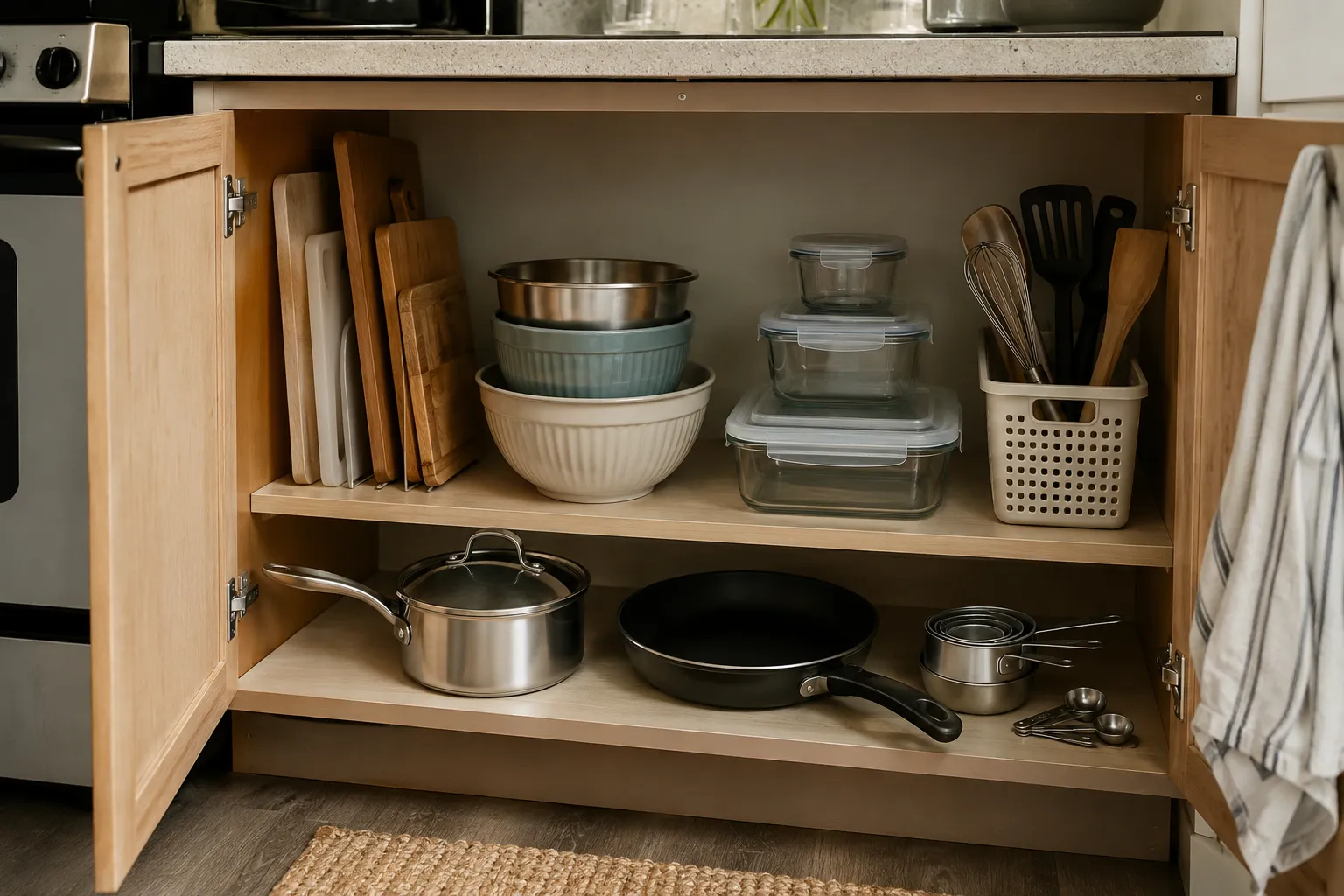
For a small kitchen, the storage strategy matters as much as the containers themselves. Nesting bowls, stackable containers, upright cutting boards, and cookware that fits inside other cookware all make a difference when cabinet space is limited. Before buying any new tool, ask yourself where it will live. A tool without a designated spot quickly becomes counter clutter.
Cleaning and Food Safety Basics
A clean kitchen is easier to cook in, and a few basic cleaning tools keep things under control.
Dish soap and a scrubbing brush or sponge. The basics you will use every day. A dish-drying rack that fits your sink area makes cleanup less of a chore.
Dish towels. Two or three cotton dish towels handle drying hands, wiping counters, and covering rising dough. Rotate them regularly to keep them fresh.
Kitchen surface cleaner. A multi-surface cleaner or a simple vinegar-water solution handles counters, stovetops, and tables.
Trash can. A small kitchen trash can with a lid keeps odors contained. In a small apartment, a slim can that tucks beside a cabinet or under the sink saves floor space.
Food safety in a first apartment is mostly about basics: wash your hands before cooking, keep raw meat separate from other ingredients, refrigerate leftovers promptly, and do not leave perishable food out at room temperature for hours. A simple food thermometer can be helpful for checking that meat is cooked through without having to guess.
Kitchen Tools That Can Wait
Kitchen stores are full of specialty tools that look useful but rarely earn their space in a beginner’s kitchen. These are the items most people can skip at first:
- Garlic press. A chef’s knife minces garlic just as well and is easier to clean.
- Stand mixer. Heavy, expensive, and takes up significant counter space. A hand mixer or a whisk covers most beginner baking.
- Immersion blender. Useful for soups and sauces, but a regular blender or simply mashing with a fork works for many recipes.
- Mandoline slicer. Fast at slicing but easy to cut yourself on. A sharp knife and a little patience do the same job more safely for beginners.
- Specialty gadgets. Avocado slicers, egg separators, herb strippers, and similar single-task tools rarely earn their place in a small kitchen. Most of these tasks take a few extra seconds with a knife.
- Large appliances. Rice cookers, slow cookers, air fryers, and pressure cookers can be useful, but they take up space and are not essential for getting started. Add them later if your cooking routine calls for them.
The pattern is clear: if a tool does only one specific thing and you do not do that thing at least once a week, it probably does not need to live in your kitchen.
Simple First Apartment Kitchen Checklist
Use this checklist to build a starter kitchen that covers everyday cooking without crowding your cabinets.
Prep tools:
- Chef’s knife (8-inch)
- Paring knife
- Cutting board (medium, wood or plastic)
- Measuring cups (dry set)
- Measuring spoons
- Liquid measuring cup
- Mixing bowls (2–3, nesting)
- Colander or strainer
Cookware:
- Nonstick skillet (10-inch or 12-inch)
- Saucepan with lid (2-quart or 3-quart)
- Sheet pan
- Stockpot (5-quart or 6-quart, or add later)
Utensils:
- Spatula or turner
- Wooden spoon or silicone spoon
- Tongs
- Whisk
- Vegetable peeler
- Can opener
- Kitchen scissors
Eating and drinking:
- Dinner plates (4)
- Bowls (4)
- Drinking glasses (4)
- Mugs (4)
- Flatware set (forks, knives, spoons for 4)
Food storage:
- Food storage containers (stackable set, various sizes)
Cleaning:
- Dish soap
- Scrubbing brush or sponge
- Dish towels (2–3)
- Surface cleaner
- Trash can
This list is not meant to be bought all at once. Start with the tools that match the meals you make most often, and add the rest as your cooking routine grows.
FAQ
What is the most important kitchen tool for a beginner?
A good chef’s knife. It handles the vast majority of cutting, chopping, and slicing tasks. Paired with a cutting board, it is the foundation of almost every meal. Spend a little more on a comfortable, sharp knife and take care of it. A dull knife is more dangerous than a sharp one because it requires more force and is more likely to slip.
Do I need a full knife set?
No. A chef’s knife, a paring knife, and maybe a serrated bread knife cover everything most beginners need. Knife blocks with twelve matching knives look impressive but often include pieces you will never use. Start with a chef’s knife and add a paring knife. That pair handles almost everything.
How much should I spend on kitchen tools for a first apartment?
You do not need to spend a lot to get a functional starter kitchen. A decent chef’s knife, a cutting board, a skillet, a saucepan, a few mixing bowls, and basic utensils can all be bought without overspending. Prioritize the knife and the skillet — those are tools you use every day. For items like measuring cups, mixing bowls, and utensils, affordable options work just as well as expensive ones for most beginners.
What cookware material is best for a beginner?
A nonstick skillet is the most beginner-friendly pan. It is forgiving, easy to clean, and works well for eggs, pancakes, and sautéed vegetables. Pair it with a stainless steel or nonstick saucepan for soups, rice, and pasta. You do not need a full matching set. Mixing materials based on what each pan does best is more practical than buying a boxed set.
How do I store kitchen tools in a small apartment?
Use nesting bowls and measuring cups that stack inside each other. Store cutting boards upright against the side of a cabinet. Choose stackable food storage containers. Hang utensils on a wall rail or keep them in a utensil crock next to the stove if counter space allows. If the kitchen has very little cabinet space, a small rolling cart or a freestanding shelf can hold cookware and pantry items without permanent installation.
What kitchen tools can I skip as a beginner?
Skip single-task gadgets like garlic presses, avocado slicers, egg separators, and mandoline slicers. Skip large appliances like stand mixers, air fryers, and rice cookers until you know you will use them regularly. Skip full knife blocks and oversized cookware sets. Most beginners cook simpler meals than they expect to, and a smaller set of reliable tools is easier to use and maintain than a kitchen full of things you rarely touch.
How do I know if a kitchen tool is worth buying?
Ask yourself three questions. First, will I use this at least once a week? Second, do I have a specific place to store it? Third, does something I already own do the same job well enough? If the answer to the first two questions is no, or the answer to the third is yes, the tool probably can wait. This simple test prevents most impulse purchases that end up gathering dust in the back of a cabinet.
Once the basics are covered, see small appliances that save space in a tiny kitchen or apartment before adding countertop equipment.
Final Thoughts
A first apartment kitchen does not need to be fully equipped to be functional. It needs a small set of reliable tools that match the way you actually cook.
Start with a good chef’s knife, a cutting board, one skillet, one saucepan, a few mixing bowls, and the utensils you reach for daily. Build from there as your routine grows. A small, well-chosen kitchen is easier to cook in, easier to clean, and easier to keep organized than one filled with tools you rarely use.
The best kitchen tool is the one that earns its place every day. Everything else can wait.