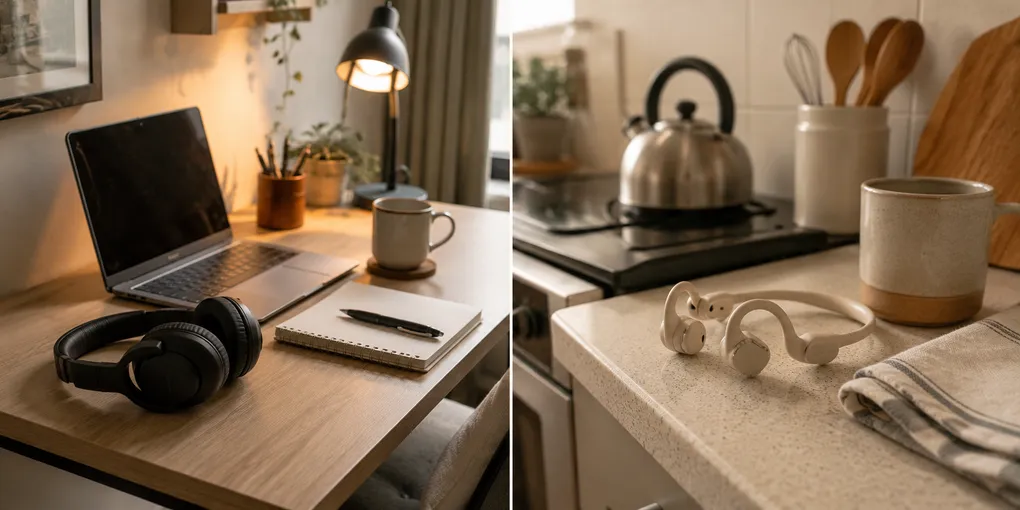
Noise-canceling headphones and open-ear headphones sit at opposite ends of how you relate to sound at home. One tries to block the world out. The other is designed to let the world in. Neither is objectively better than the other. The right one depends on what you do most often while wearing headphones, what kind of home you live in, and whether you need to hear your surroundings or escape from them.
This guide compares noise-canceling and open-ear headphones for the main home activities: working, studying, cooking, cleaning, taking calls, and relaxing. It focuses on how each style fits into a real home routine, not on technical specs or brand comparisons.
If you are still deciding on a headphone style in general, our guide on how to choose headphones for working, studying, and relaxing at home covers the broader decision between over-ear, on-ear, and earbud styles.
Noise-Canceling vs. Open-Ear Headphones: The Basic Difference
Noise-canceling headphones use microphones and electronic processing to reduce outside sound. Active noise canceling works best on steady, low-frequency noise like traffic, airplane hum, air conditioner rumble, and distant construction. Most noise-canceling headphones are closed-back over-ear designs, which also provide passive noise isolation from the ear cups.
Open-ear headphones do the opposite. Instead of sealing out sound, they leave the ear canal open so you can hear your surroundings clearly while still listening to audio. Some open-ear designs use bone conduction technology that sends sound through the cheekbones. Others use small speakers that sit just outside the ear canal without blocking it. Neither style seals the ear.
The core trade-off is simple. Noise-canceling headphones give you isolation and immersion. Open-ear headphones give you awareness and connection to your environment. At home, both have real value. The question is which one matches more of your daily activities.
When Noise-Canceling Headphones Make Sense at Home
Noise-canceling headphones shine in a few specific home situations. If several of these describe your daily life, noise canceling is likely the better fit.

Best for Focused Work and Study
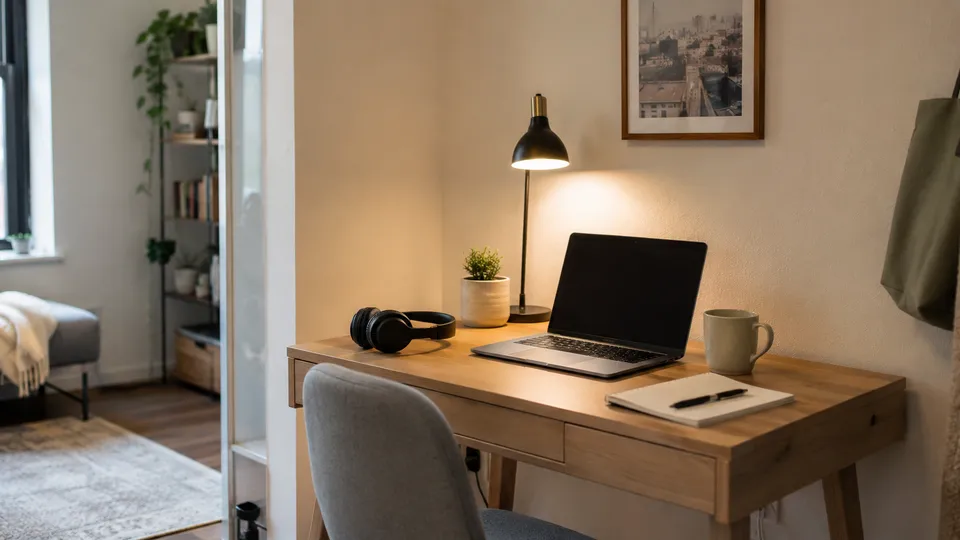
When you need to concentrate for hours, blocking out background noise helps. Noise-canceling headphones reduce the steady hum of traffic, HVAC systems, and distant construction that can break focus even when the noise is not loud. Combined with music, ambient sound, or white noise at a moderate volume, they create a quieter mental space for deep work.
This is especially useful in a small apartment where the desk might be near the kitchen, the living area, or a shared wall. Noise-canceling headphones cannot silence conversation or sudden sounds, but they can take the edge off the background noise that makes concentration harder than it needs to be.
Best for Shared Homes and Thin Walls
If you share your home with other people — roommates, a partner, kids — noise-canceling headphones can be a practical way to manage noise without asking everyone else to be quiet. They also work the other direction: closed-back noise-canceling headphones leak less sound outward, so your music or podcast does not disturb someone working or sleeping nearby.
In an apartment building with thin walls, noise-canceling headphones can reduce the low rumble of a neighbor’s TV, footsteps from the unit above, or street noise that seeps through windows. They will not eliminate these sounds, but they can make them less intrusive.
Best for Immersive Listening and Evening Wind-Down
When you want to get lost in music, a podcast, or a movie without distraction, noise-canceling headphones create a more immersive experience. The combination of active noise canceling and passive isolation makes the audio feel closer and more detailed, even at moderate volume.
For evening relaxing — watching a movie while a partner sleeps, listening to music before bed, or playing a game — noise-canceling headphones keep the sound contained and the outside world at a distance.
When Open-Ear Headphones Make Sense at Home
Open-ear headphones solve a different set of problems. They are the better choice when you need to stay connected to your surroundings while still having audio in your ears.
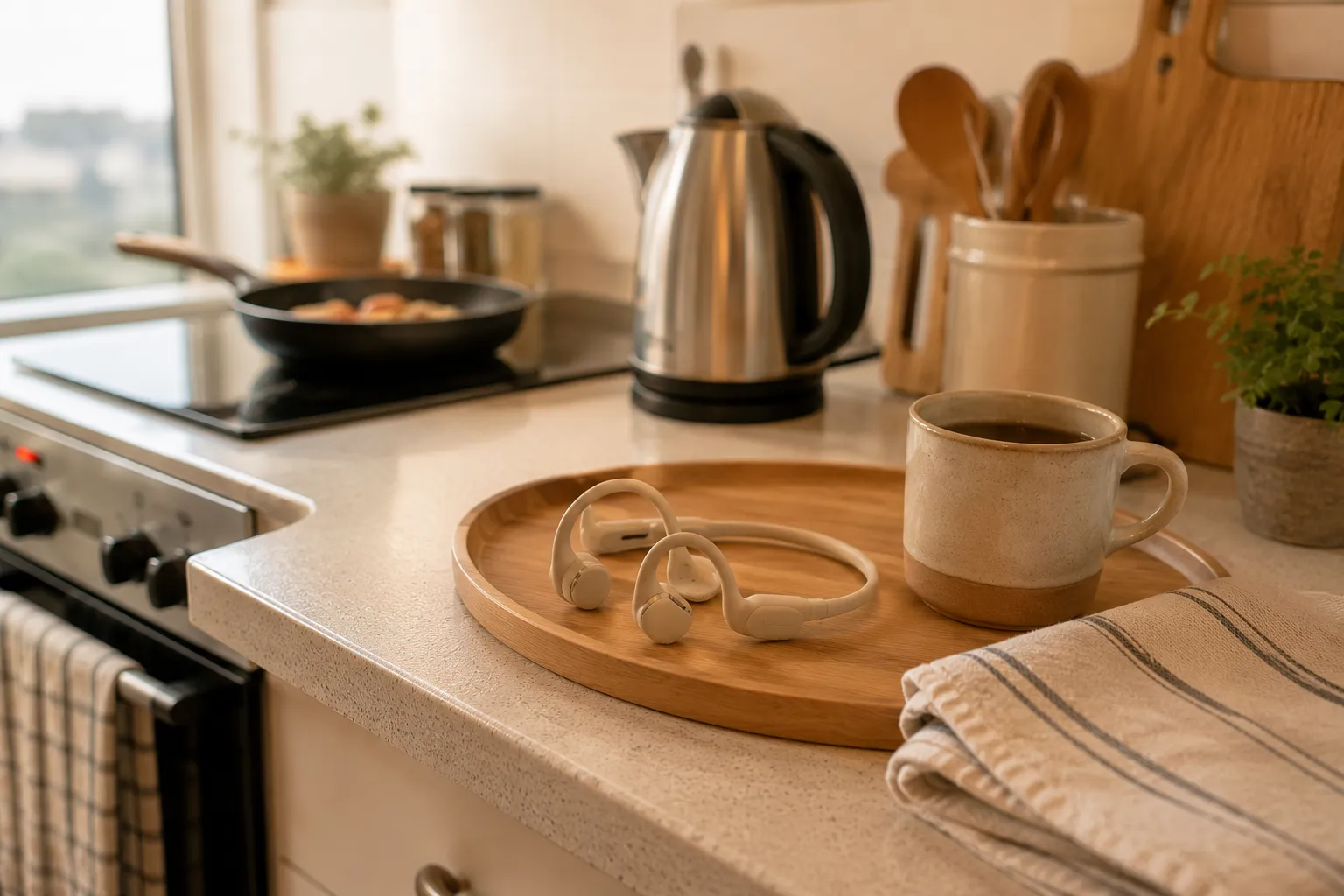
Best for Cooking, Cleaning, and Moving Around
Open-ear headphones are the most practical choice for home activities where you are on your feet and moving. Cooking involves timers, boiling water, sizzling pans, and the sound of a knife on a cutting board. Cleaning involves moving between rooms, hearing a knock at the door, or catching the laundry buzzer. In all of these situations, blocking out sound with noise-canceling headphones can be a safety issue or a practical annoyance.
Open-ear headphones let you listen to a podcast, music, or an audiobook while still hearing everything you need to hear in the kitchen or around the apartment. You stay aware of your environment without pausing or removing the headphones.
Best for Parents and Caregivers at Home
If you are responsible for a child, an elderly relative, or a pet that needs attention, open-ear headphones let you stay tuned in to what is happening around you. A baby monitor, a child calling from another room, a dog scratching at the door — these are sounds you need to hear, not block out.
Noise-canceling headphones can make sense during a dedicated focus block if someone else is on duty. But for the ordinary flow of a day at home with dependents, open-ear headphones are usually the safer, more practical choice.
Best for Taking Calls While Staying Present
Open-ear headphones are useful for voice calls when you want to stay aware of your environment. On a work call while pacing around the apartment, you can hear if someone at the door or if the oven timer goes off. On a casual call with a friend while folding laundry, you can stay in the conversation without sealing yourself off from the room.
The call quality on open-ear headphones is typically good enough for conversation, though not as isolated as a dedicated headset with a boom microphone. For casual and semi-professional calls, the trade-off between call isolation and environmental awareness often favors awareness.
Transparency Mode: The Middle Ground
Some noise-canceling headphones include a transparency mode — also called ambient sound or hear-through mode — that uses the external microphones to pipe outside sound into the ear cups. It is an attempt to give you the best of both worlds: noise canceling when you want isolation and awareness when you need it.
Transparency mode works well enough for quick awareness moments: hearing a doorbell, catching a brief announcement, or having a short conversation without removing the headphones. But it is not the same as open-ear headphones for all-day awareness. The sound piped in through transparency mode can feel slightly artificial, and it still relies on battery power and electronics. Open-ear headphones provide awareness passively, without electronics, and the sound of the real world feels more natural.
If you mostly need isolation but occasionally need awareness, noise-canceling headphones with a good transparency mode can be a practical compromise. If you need awareness most of the time, open-ear headphones are the simpler and more reliable choice.
Comfort, Fit, and Storage Matter More Than You Think
Both headphone styles have comfort trade-offs that matter for home use, where you might wear them for hours at a time.
Noise-canceling headphones are almost always over-ear designs, which distribute weight around the ears and across the headband. For long desk sessions, this is often the most comfortable format. The trade-off is heat and pressure. Over-ear cups can feel warm after a couple of hours, and the clamp force that helps with passive noise isolation can become noticeable over a full workday.
Open-ear headphones come in more varied designs: bone conduction bands that wrap around the back of the head, clip-on styles that hook over the ear, or earbud-style open designs that sit in the outer ear without sealing. Most are lighter than over-ear noise-canceling headphones, and none create the warm, sealed feeling of closed-back ear cups. This makes them more comfortable for all-day wear in terms of heat and weight, but the fit is more personal — some people find behind-the-head bands or ear hooks uncomfortable after several hours.
Storage matters in a small apartment. Over-ear noise-canceling headphones take up more space and benefit from a hook on the wall or the side of a desk. Open-ear headphones are usually smaller and easier to toss in a drawer, a tray, or a small case. If desk or shelf space is limited, the smaller footprint of open-ear headphones can be a real advantage.
Noise-Canceling vs. Open-Ear Headphones at a Glance
| Situation | Noise-Canceling | Open-Ear |
|---|---|---|
| Deep-focus work or study | Excellent — blocks background hum and creates a quieter mental space | Fair — music or ambient sound helps, but background noise still comes through |
| Video calls in a quiet room | Good — isolates your voice and blocks room tone | Good — lets you hear your own voice naturally and stay aware of the room |
| Cooking and cleaning | Poor — blocks sounds you need to hear like timers, boiling water, or a knock at the door | Excellent — lets you hear everything while still listening to audio |
| Shared home or thin walls | Excellent — reduces neighbor and housemate noise, and leaks less sound outward | Poor — background noise is still audible, and audio can leak outward at higher volumes |
| Moving between rooms | Fair — bulky for quick movement, and isolation limits awareness | Excellent — light, stays in place, and keeps you aware as you move |
| Evening TV or movies | Excellent — immersive sound and no leakage to disturb others | Fair — audio is less immersive and may be audible to someone nearby |
| All-day wear (8+ hours) | Good — comfortable for desk work, but ear cups can feel warm over time | Good — lighter and cooler, but fit style may not suit everyone |
| Parents and caregivers | Poor — blocks sounds you need to hear from dependents | Excellent — keeps you fully aware while still providing audio |
What to Avoid When Choosing Between These Two Styles
A few common mistakes lead people to pick the wrong style for their home life.
Buying noise-canceling headphones because they are the premium option. Noise canceling is a feature, not a universal upgrade. If you live alone in a quiet apartment and mostly listen to music while doing chores, open-ear headphones may serve you better than the most expensive noise-canceling set on the market.
Buying open-ear headphones and expecting immersive sound. Open-ear headphones are not designed for deep, isolated listening. If your main use is getting lost in music or movies, noise-canceling headphones are the better tool for that job. Open-ear headphones prioritize awareness over immersion.
Assuming you need only one pair. Many people who work from home end up owning both styles: noise-canceling headphones for focused desk work and evening relaxation, and open-ear headphones for chores, movement, and casual listening. The two styles serve different parts of the day. You do not need to buy both at once, but it is worth knowing that one pair may not cover every home scenario.
Ignoring comfort because you are focused on the noise feature. The noise-canceling vs. open-ear decision matters, but comfort matters more. Headphones you do not want to wear are headphones you will not use, regardless of how good the noise canceling or the open-ear awareness is.
FAQ
Can I use noise-canceling headphones for cooking and cleaning?
You can, but it is not ideal. Noise-canceling headphones block sounds you may need to hear, like timers, boiling water, sizzling pans, or someone at the door. If you do use them in the kitchen, keep the volume low, enable transparency mode if available, and stay visually aware of what is happening on the stove and around you.
Are open-ear headphones good for music?
They are good enough for casual listening, but they are not designed for immersive, detailed music experiences. Because the ear is open, bass response is usually weaker, and background noise competes with the audio. If music is your main focus, noise-canceling or closed-back over-ear headphones will deliver a fuller, more detailed sound. If music is background while you do other things, open-ear headphones perform well enough.
What is transparency mode and can it replace open-ear headphones?
Transparency mode on noise-canceling headphones uses external microphones to pipe outside sound into the ear cups. It works for brief awareness moments — hearing a doorbell, having a short conversation — but it does not feel as natural as open-ear headphones for all-day use. The sound can feel slightly processed, and it depends on battery power. Open-ear headphones provide passive, natural awareness without electronics.
Which style is better for a small apartment with thin walls?
Noise-canceling headphones. They reduce the steady background noise from neighbors, traffic, and building systems. They also leak less sound outward, so your audio does not travel through the walls to your neighbors. Open-ear headphones let in more ambient noise and can leak sound outward at higher volumes, which is less ideal in a shared-wall situation.
Can I take work calls with open-ear headphones?
Yes. Open-ear headphones work well for calls, especially if you want to stay aware of your environment while talking. The microphone quality varies by model, but most handle conversation clearly enough for casual and semi-professional calls. If you take calls in a noisy environment, noise-canceling headphones with a good microphone may provide better call clarity for the person on the other end.
Should I buy both noise-canceling and open-ear headphones?
If your budget and space allow, owning both is practical. Noise-canceling headphones for focused desk work and evening relaxation, plus open-ear headphones for chores, movement, and casual listening, cover the full range of home activities. Start with the style that matches the activity you do most often, and add the other later if you find gaps in your routine.
Do open-ear headphones work for watching TV or movies?
They work, but the experience is less immersive than with noise-canceling or closed-back headphones. Dialogue and sound effects are clear enough, but background noise in the room competes with the audio, and bass is usually weaker. If you primarily watch TV or movies alone, noise-canceling headphones provide a better experience. If you need to stay aware of your surroundings while watching, open-ear headphones are a reasonable compromise.
For the broader fit, comfort, and device-choice checklist, read how to choose the best headphones for working, studying, and relaxing at home.
Final Thoughts
Noise-canceling and open-ear headphones are not competitors. They are tools for different parts of the day.
Noise-canceling headphones are best when you want to block out the world, focus deeply, or get lost in music or a movie. They make the most sense for desk work, studying, evening relaxing, and shared homes where background noise is a constant presence.
Open-ear headphones are best when you want to stay connected to your environment while still having audio in your ears. They make the most sense for cooking, cleaning, moving around the apartment, and any situation where awareness matters as much as what you are listening to.
The question is not which style is better in the abstract. It is which style fits more of the hours in your actual day. For many people working and living at home, the answer ends up being both — one pair for focus and immersion, another for movement and awareness.