Choosing headphones for home use is different from choosing headphones for commuting, the gym, or a noisy open office. At home, comfort matters more than portability. Microphone quality matters if you take video calls. Noise handling matters if you share walls with neighbors or live with other people.
This guide walks through how to choose headphones that work well for the main home activities: focused work, studying, video calls, music, and relaxing in the evening. It focuses on what actually makes a difference day to day, not on spec sheets or audiophile details.
Start With How You Will Actually Use Them
Before comparing styles or features, think about the main ways you will use headphones at home. The answer changes what to prioritize.
Someone who wears headphones for hours of deep-focus work needs all-day comfort above everything else. Someone who takes back-to-back video calls needs clear microphone quality and a reliable connection. Someone who mostly listens to music while cooking or cleaning may prefer wireless earbuds they can move around in. Someone who watches TV or movies at night while a partner sleeps needs low-latency wireless and comfortable ear cups for lying on the sofa.
Most people use headphones in more than one way. Identify your primary use — the thing you do most often while wearing headphones — and let that drive the choice. Secondary uses can influence the final pick but should not override what matters most for your main activity.
Over-Ear, On-Ear, or Earbuds for Home
Each headphone style has a different trade-off for home use. The right one depends on your comfort preferences, how long you wear them, and whether you need to hear your surroundings.
Over-Ear Headphones for Home Use
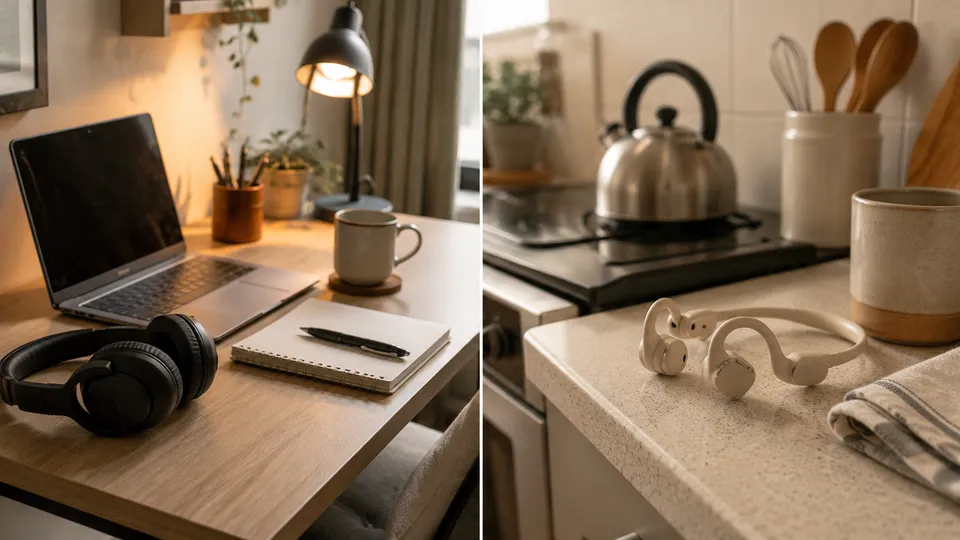
Over-ear headphones have large ear cups that surround the ears rather than pressing on them. For home use, this is often the most comfortable style for long sessions. The ear cups distribute pressure around the ears instead of on them, and the headband spreads weight across the top of the head.
The main advantage for home use is comfort over hours. If you wear headphones for a full workday or a long study session, over-ear headphones tend to be less fatiguing than on-ear or in-ear options. They also tend to have better passive noise isolation simply because the ear cups block more sound.
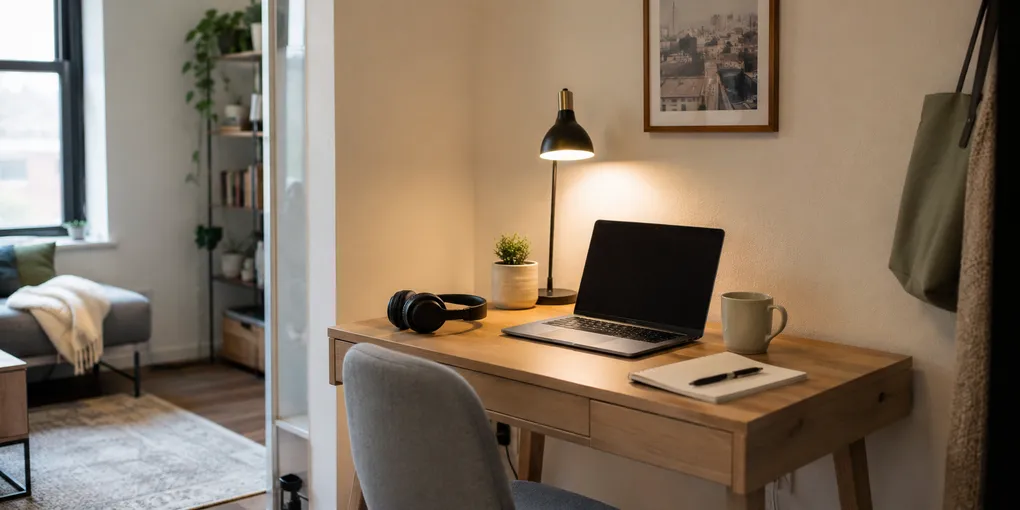
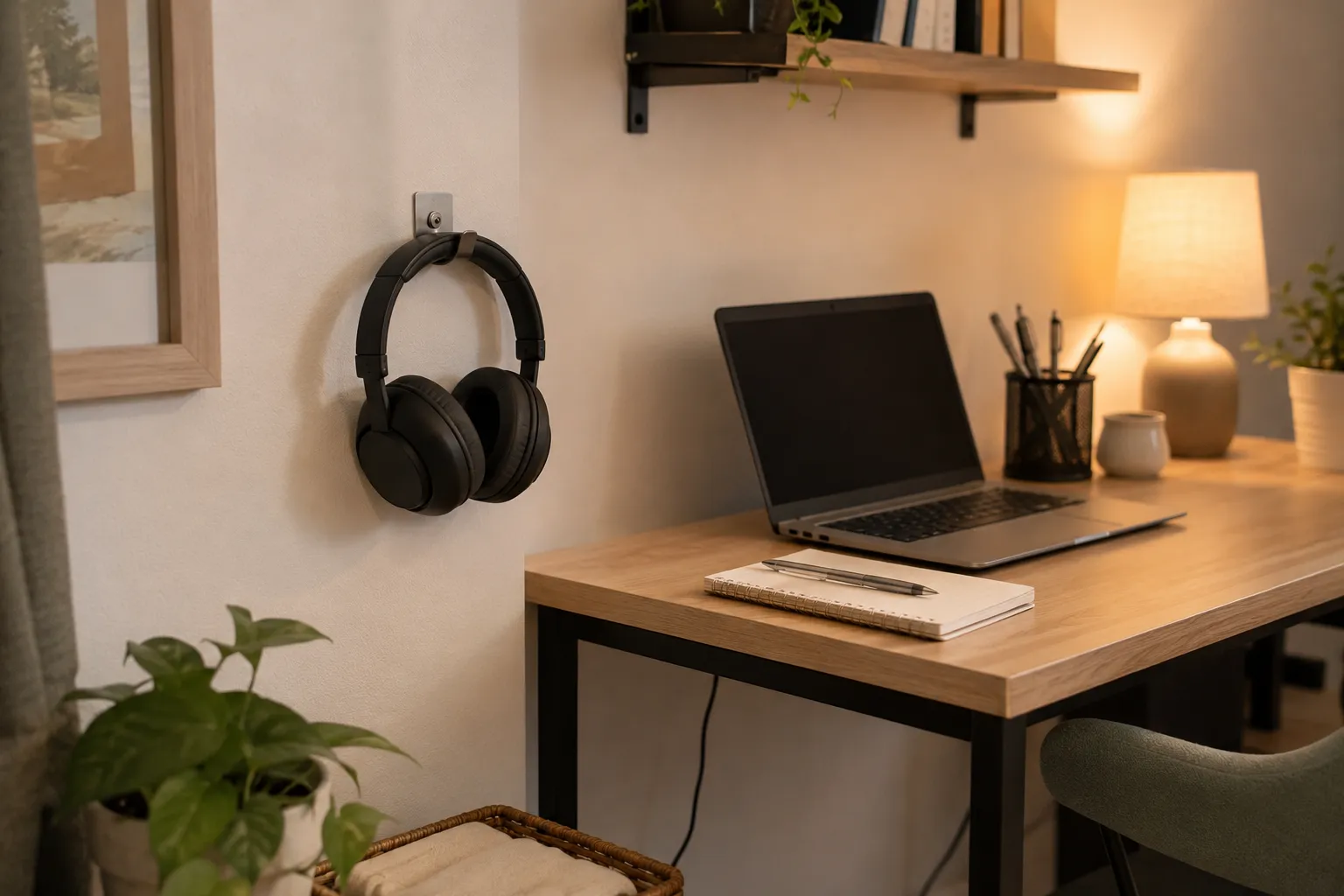
The trade-offs are size and heat. Over-ear headphones take up desk space when not in use. They can also feel warm after a couple of hours, especially in a room without good airflow. A simple headphone hook on the wall or the side of a desk solves the storage issue and keeps them off the work surface.
Wireless Earbuds for Apartments
True wireless earbuds are small, light, and easy to move around in. For home use, they are most practical for activities where you are not sitting at a desk: cooking, cleaning, stretching, or walking around the apartment while on a call.
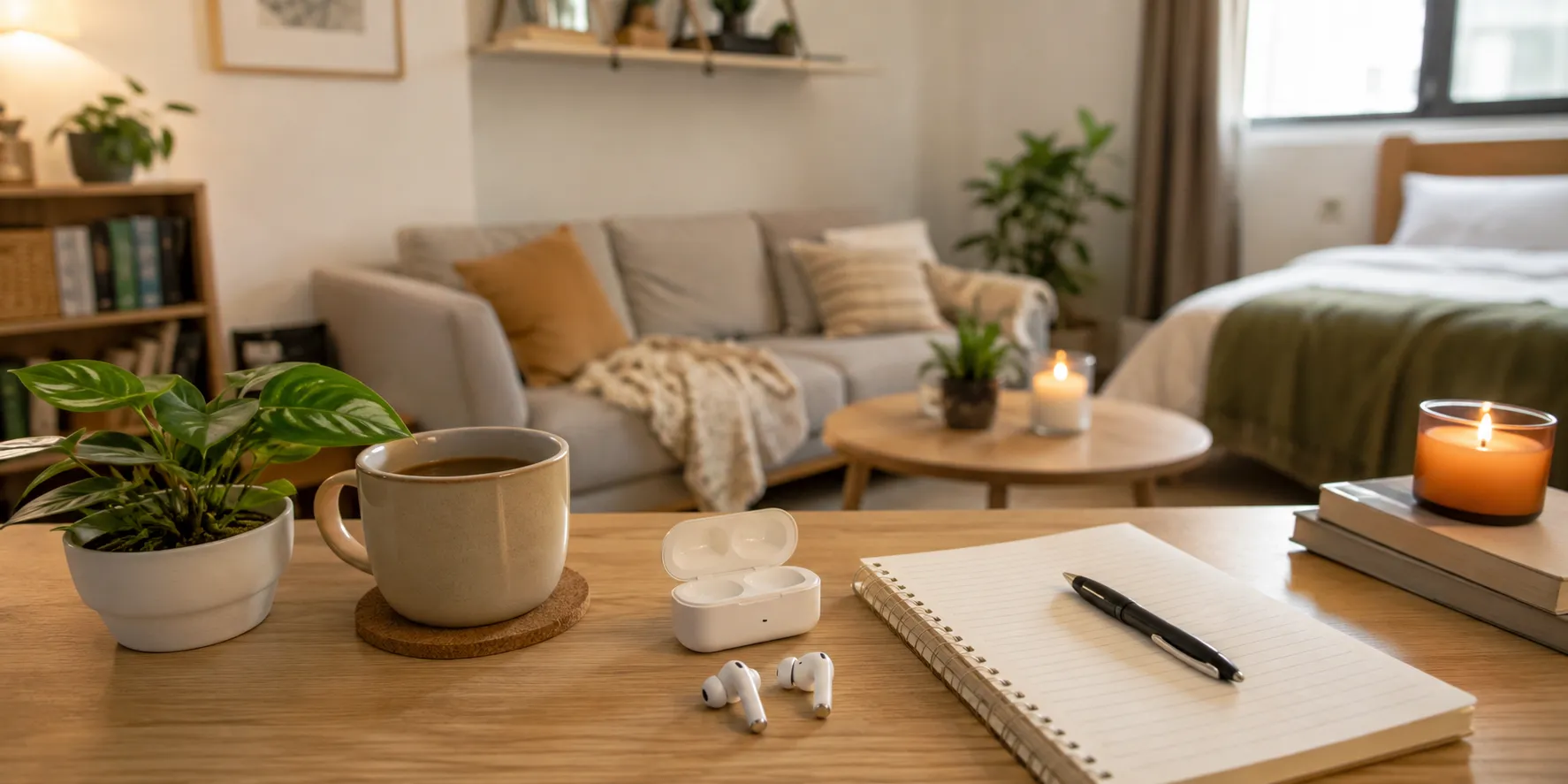
The main advantage of earbuds for home use is freedom of movement. You can leave your phone on the counter, walk to another room, and stay connected. They are also easy to store — a small tray or dish on the desk or nightstand holds them without adding clutter.
The trade-off is comfort over long periods. Most earbuds become noticeable in the ear after a couple of hours. Battery life is also shorter than over-ear headphones, typically lasting four to eight hours before needing a charge in the case. For all-day desk work, over-ear headphones are usually more comfortable. For short calls, chores, and evening wind-down, earbuds can be the more practical choice.
On-Ear Headphones
On-ear headphones sit on the ears rather than around them. They are smaller and lighter than over-ear headphones but press directly on the ears, which can become uncomfortable after an hour or two. For home use, where portability matters less, on-ear headphones are rarely the best choice for long sessions. They can work for short calls or quick listening sessions but tend to fall behind over-ear and earbud options for all-day comfort.
Noise Handling at Home
Home noise falls into two categories: noise from inside your home and noise from outside. Which one matters more depends on your living situation.
If you live alone in a quiet apartment, noise handling may not be a priority at all. If you share walls with neighbors, live on a busy street, or share your home with other people, it becomes much more important.
Active Noise Canceling
Active noise canceling uses microphones to detect outside noise and create an opposite sound wave to cancel it. It works best on steady, low-frequency noise like traffic hum, airplane cabin noise, air conditioner rumble, and distant construction. It is less effective on sudden, irregular sounds like conversation, door slams, or a dog barking.
For home use, active noise canceling is most useful if you live near a busy road, under a flight path, or next to ongoing construction. It can also help in an apartment building with constant HVAC noise or elevator hum. If your home is already fairly quiet, active noise canceling may be a feature you pay for but rarely need.
Passive Noise Isolation
Passive isolation is simply how well the headphones physically block sound. Over-ear headphones with closed-back ear cups provide the most passive isolation. Earbuds with a tight seal in the ear canal also block a meaningful amount of sound.
Passive isolation is often enough for home use. It reduces keyboard typing noise, distant conversation, kitchen sounds, and other common home noise without requiring electronics or battery drain. For most people working or studying at home, good passive isolation paired with music or ambient sound at a moderate volume covers the need.
Transparency Mode
Transparency mode — sometimes called ambient sound or hear-through mode — uses the headphone microphones to let outside sound in. It is useful at home when you need to hear a doorbell, a timer, a partner calling from another room, or a baby monitor.
If you wear headphones for long stretches at home, transparency mode is worth having. It lets you stay aware of your surroundings without taking the headphones off. This is especially useful in a shared home or apartment where you might need to hear someone at the door or something on the stove.
Comfort Comes Before Specs
For home use, comfort matters more than almost any other feature. Headphones you do not want to wear are headphones you will not use, no matter how good they sound.
The main comfort factors are clamp force, ear cup material, and weight. Clamp force is how tightly the headphones grip your head. Too tight and they cause pressure and headaches after an hour. Too loose and they slide around or feel unstable. The sweet spot is firm enough to stay in place but light enough to forget you are wearing them.
Ear cup material and depth matter for long sessions. Plush ear pads with memory foam tend to be more comfortable than thin or stiff padding. Deep ear cups that do not press on the edges of your ears are better for all-day wear. If you wear glasses, look for ear cups with softer padding that accommodate the arms of your frames without creating pressure points.
Weight is less adjustable but still worth paying attention to. Lighter headphones are generally more comfortable for long sessions. A difference of 30 or 40 grams may not seem like much on paper, but it adds up over four or five hours.
Microphone Quality for Video Calls
If you take video calls or voice calls at home, microphone quality matters. A headphone set that sounds great for music but makes your voice sound distant, muffled, or robotic to the person on the other end is frustrating for everyone involved.
Good call quality comes down to microphone placement and noise handling. Headphones with a boom arm or a microphone positioned closer to the mouth tend to pick up voice more clearly than those with microphones embedded in the ear cup. Some headphones also include noise reduction on the microphone side, which helps filter out keyboard typing, fan noise, and background sounds so your voice comes through more clearly.
If calls are a major part of your day, prioritize a headset with a good microphone over one with the best music sound. The person on the other end of the call will notice microphone quality far more than you will notice a slight difference in music tuning.
Bluetooth Connection and Battery Life
For home use, Bluetooth reliability matters more than Bluetooth version numbers. What you want is a connection that stays stable when you walk from your desk to the kitchen, does not cut out when your phone is in your pocket, and pairs reliably every time.
Multipoint Bluetooth is a useful feature for home use. It lets the headphones connect to two devices at the same time — a laptop and a phone, for example — and switch between them automatically. If you listen to music on your laptop but take calls on your phone, multipoint saves you from manually reconnecting every time.
Battery life needs depend on how long you wear the headphones each day. For all-day desk work, look for headphones that can last a full workday on a single charge, including some buffer for days that run long. Many over-ear headphones now last 20 to 40 hours. Wireless earbuds typically last 4 to 8 hours on a single charge, with the case providing additional charges.
A quick-charge feature is also useful at home. Some headphones can give you a few hours of listening time from a 10- or 15-minute charge, which is helpful when you sit down to work and realize the battery is nearly dead.
Matching Headphones to Real Home Scenarios
Different home routines call for different headphone choices. Here is how a few common scenarios break down.
Remote work with frequent video calls. Over-ear headphones with a good microphone, all-day comfort, and multipoint Bluetooth for switching between laptop and phone. Active noise canceling is a plus if the home environment is noisy.
Deep-focus studying or writing. Over-ear headphones with excellent comfort for long sessions and good passive noise isolation. Active noise canceling can help if there is steady background noise. Transparency mode is useful for hearing a timer or a knock on the door without breaking focus.
Music while cooking, cleaning, or moving around. Wireless earbuds. They stay out of the way, let you move freely, and are easy to pause or take out when you need to hear something. Transparency mode is helpful for hearing timers, boiling water, or someone at the door.
Evening TV, movies, or gaming while others sleep. Over-ear headphones with comfortable ear cups for lounging, low-latency Bluetooth for synced audio with video, and good passive isolation so sound does not leak out and disturb others. A long battery life covers movies and extended gaming sessions without interruption.
Living in a shared apartment with thin walls. Over-ear headphones with good passive isolation or active noise canceling. The ability to listen at a moderate volume without cranking it up to drown out neighbor noise is better for your hearing and your relationship with the people on the other side of the wall.
What to Avoid When Choosing Headphones for Home
A few common mistakes lead people to buy headphones that do not fit their actual home use.
Buying for the ideal scenario instead of the real one. Headphones with incredible sound quality for music do not help if your main use is video calls and the microphone sounds terrible. Match the headphones to your real daily activities.
Prioritizing noise canceling over comfort. Active noise canceling is a nice feature, but if the headphones are too tight to wear for more than an hour, you will not use them long enough for the noise canceling to matter. Comfort first.
Ignoring microphone quality because “I do not take that many calls.” If you take even two or three calls a week, a bad microphone makes every one of those calls worse. The person on the other end will notice, and you will spend half the call repeating yourself.
Overpaying for features you will not use at home. Spatial audio, head tracking, and elaborate equalizer apps are less important at home than comfort, connection stability, and battery life. Spend on what you will actually notice day to day.
Buying headphones that are hard to store. In a small apartment or a minimalist desk setup, headphones that do not fold, do not come with a case, and take up significant space can become a daily annoyance. A simple hook, stand, or drawer spot solves this, but only if you plan for it.
FAQ
Should I get over-ear headphones or wireless earbuds for home use?
For long desk sessions — working, studying, or writing — over-ear headphones are usually more comfortable. For moving around the apartment, cooking, cleaning, or short calls, wireless earbuds are more practical. Many people end up owning one of each for different situations. If you can only get one, pick the style that matches the activity you do most often while wearing headphones.
Do I need active noise canceling for home use?
Not necessarily. If your home is fairly quiet, good passive noise isolation from closed-back over-ear headphones or well-sealed earbuds is often enough. Active noise canceling is most useful if you live near steady noise like traffic, construction, or loud HVAC systems. For most home environments, passive isolation plus music or ambient sound at a moderate volume handles the need.
What is the most important feature for headphones used at home?
Comfort. Headphones you do not want to wear are headphones you will not use. For home use, where you might wear them for hours at a time, comfort matters more than sound quality, noise canceling, or battery life. Look for headphones with a comfortable clamp force, plush ear cups, and a weight you can tolerate for long stretches.
How important is microphone quality if I only take a few calls a week?
Even a few calls a week makes microphone quality worth considering. A bad microphone makes every call frustrating for both you and the person on the other end. If calls are not your main use but still happen regularly, look for headphones with at least decent call quality rather than prioritizing only music or sound performance.
What is multipoint Bluetooth and do I need it?
Multipoint lets your headphones connect to two devices at the same time, such as a laptop and a phone. It automatically switches between them when a call comes in or when you start playing audio on one device. It is useful at home if you frequently switch between a laptop for work or study and a phone for calls or quick listening. It is not essential, but it saves the small daily annoyance of manually reconnecting.
Can I use the same headphones for work calls and evening relaxing?
Yes. Over-ear headphones with good comfort, decent microphone quality, and long battery life can cover both. The same pair that handles your work calls during the day can handle music or a movie at night. Look for a pair that performs well enough in both areas without being specialized for either.
How do I store headphones in a small apartment?
A simple headphone hook on the side of a desk or on a wall keeps over-ear headphones off the work surface without taking up drawer space. Wireless earbuds can live in a small tray or dish on the desk or nightstand. If you prefer to put headphones away entirely, look for a pair that folds flat or comes with a compact case. Avoid leaving headphones on the desk as permanent clutter if desk space is already limited.
If the key tradeoff is isolation versus awareness of your home, compare noise-canceling vs. open-ear headphones.
Final Thoughts
The best headphones for home are the ones that fit your actual daily routine. That might mean plush over-ear headphones for all-day work and study. It might mean wireless earbuds for moving freely around the apartment. It might mean a single pair that splits the difference between work calls during the day and music or movies at night.
Before buying, ask yourself what you will use the headphones for most often, how long you will wear them at a time, and whether your home environment is quiet or noisy. Let those answers drive the choice more than spec sheets, brand names, or what reviewers praise for entirely different use cases.
Good headphones at home should make your day feel easier, not heavier. Comfort, reliability, and a good fit for your real routine are worth more than any feature list.